


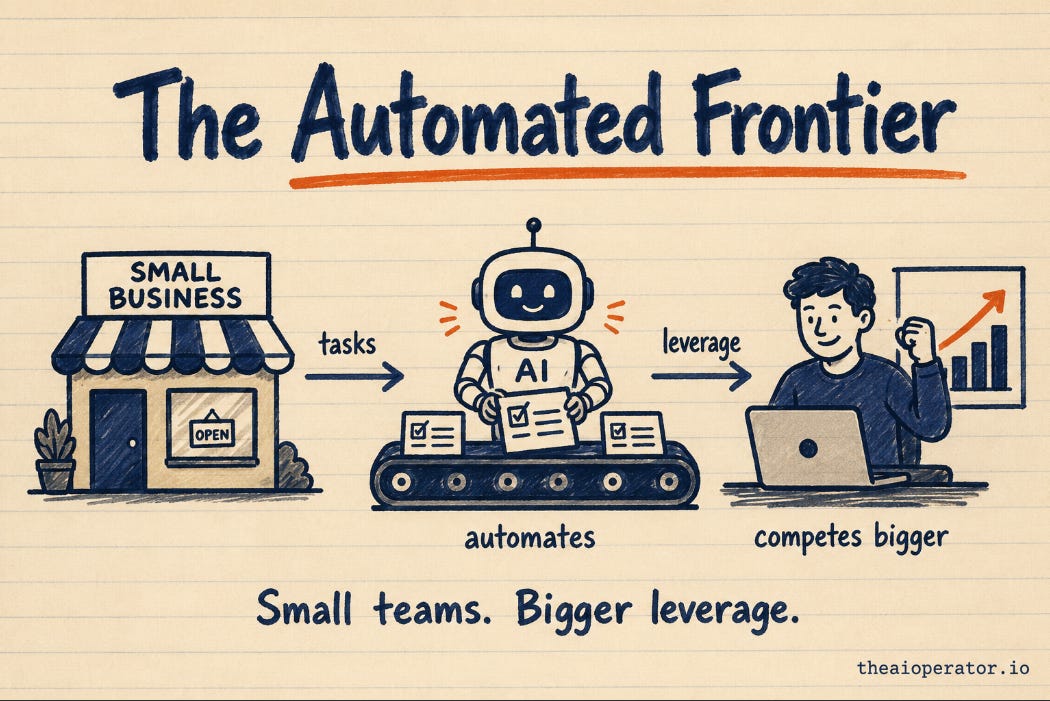
Rapid Adoption: Small and medium-sized businesses (SMBs) are integrating AI at an unprecedented rate, with adoption figures soaring to nearly 90% in some sectors, driven by accessible cloud-based tools and the undeniable competitive advantage they offer.
Transformative Benefits: AI is delivering substantial productivity gains, ranging from 29% to a remarkable 133%, alongside significant cost reductions and a projected 20% increase in revenue for early adopters. This shift is freeing up valuable human capital for strategic work.
Strategic Imperative: Beyond mere efficiency, AI has become a critical survival strategy, enabling SMBs to offer hyper-personalized customer experiences, make data-driven decisions, and innovate at a pace previously reserved for larger enterprises.
The Deep Dive: A New Era for Main Street
Artificial intelligence, once the exclusive domain of tech behemoths, has decisively arrived on Main Street. In 2026, its integration into small and medium-sized businesses (SMBs) is no longer a futuristic concept but a tangible reality, profoundly reshaping operational paradigms and competitive landscapes. The shift is dramatic: surveys reveal that up to 89% of small businesses are now leveraging AI for automation, a significant leap from just 48% in 2024. This rapid embrace underscores a growing understanding that AI is not just a tool for efficiency, but a catalyst for growth.
The allure of AI lies in its ability to empower lean teams to achieve disproportionate results. Businesses are experiencing substantial productivity boosts, with some reports indicating gains between 29% and 72%, and even up to 133% in specific cases for productivity. These figures are translating directly into increased revenue, with 85% of AI-adopting SMBs anticipating a positive return on their investment. The economic impact is profound, with projections suggesting AI could add an astounding $15.7 trillion to the global economy by 2030.
Central to this transformation is AI automation, which intelligently handles repetitive, time-consuming tasks. Unlike traditional automation that follows rigid rules, AI learns, adapts, and makes informed decisions. This capability allows small business owners and their teams to redirect their focus from mundane administrative duties to strategic planning, creativity, and deeper customer engagement. It’s akin to acquiring a tireless digital team member who continuously learns and improves.
The applications are diverse and growing, touching almost every facet of small business operations. In customer service, AI-powered chatbots and virtual assistants are now commonplace, providing 24/7 support, answering routine inquiries, and routing complex issues to human agents. This not only improves customer satisfaction but can also reduce service costs by up to 50%. For many SMBs, this means delivering enterprise-level responsiveness without the prohibitive overhead.
Marketing and sales are being revolutionized by hyper-personalization. AI tools analyze customer behavior, preferences, and browsing habits to deliver tailored product recommendations, dynamic email content, and highly targeted ad campaigns. This precision marketing, once a luxury for large brands, is now accessible to small businesses, leading to higher conversion rates and stronger customer loyalty. Generative AI, in particular, is a game-changer for content creation, enabling rapid generation of blog posts, social media updates, product descriptions, and email marketing copy, freeing up significant time for business owners.
Beyond the customer-facing roles, AI is driving significant improvements in back-office efficiency. Tools are automating invoicing, scheduling, inventory management, and data entry, drastically reducing manual errors and freeing up employee time. In financial management, AI-powered accounting software provides real-time insights, detects fraud, and automates tax preparation, enabling smarter, data-driven decision-making. This holistic automation strategy is crucial for SMBs navigating economic pressures like inflation and supply chain issues.
“”The real risk isn’t embracing AI too soon but waiting too long and falling behind more agile competitors.”“
This sentiment, articulated by Benjamin Yeh of ASUS Computer International, encapsulates the urgency driving AI adoption among SMBs. The competitive landscape is evolving rapidly, and early adopters are gaining a significant edge, leveraging AI for better analytics, improved customer responsiveness, and strengthened collaboration. Companies like ASUS are already providing AI-enabled devices that bring real-time transcription, live translation, and enhanced security to everyday business interactions.
However, the journey is not without its challenges. Skill gaps remain a significant hurdle for 44% of small businesses, alongside integration issues cited by 37%. Data privacy concerns and the evolving regulatory landscape also loom large, with 65% of small businesses worrying about new regulations. There’s also the “dark side” of AI adoption, including risks of deepfake scams targeting finance teams, data leaks from poorly trained models, and bias in AI-driven hiring or lending tools. Mitigating these risks requires careful planning, secure platforms, and a focus on responsible AI practices.
The future of AI for small businesses points towards even more integrated and intuitive solutions. No-code AI platforms are making automation accessible to non-programmers, while AI-powered assistants are taking on increasingly complex tasks like scheduling and reporting. Generative AI will continue to evolve, enhancing creativity in design and analytics. Perhaps most exciting are predictive automation capabilities, where AI anticipates customer needs and triggers actions proactively, and the rise of specialized AI agents designed for specific industry niches.
Visualizing the AI Shift
Insights from recent video discussions further illuminate the practicalities and philosophies behind AI adoption for small businesses. Several reputable YouTube channels have hosted workshops and interviews, consistently reinforcing the narrative of AI as an empowering, rather than displacing, force.
One common thread is the emphasis on starting small and purposeful. Experts advise identifying one or two repetitive, low-value tasks that consume significant time and then seeking AI tools to automate them. This pragmatic approach helps businesses see tangible benefits quickly without feeling overwhelmed. Examples shared include using AI for drafting emails, creating basic marketing content, or managing customer inquiries.
A key misconception addressed in these videos is the fear of AI replacing human jobs. Instead, the consensus among experts is that AI serves as an “intern” or a powerful assistant, augmenting human capabilities rather than outright replacing them. AI handles the “boring stuff” – the repetitive, data-heavy tasks – allowing human employees to focus on higher-value activities that require creativity, empathy, and strategic thinking. This perspective frames AI as a tool for workforce augmentation, enabling teams to achieve more with existing resources.
Videos also highlight the accessibility of current AI solutions. Many off-the-shelf, subscription-based tools require no technical expertise and are user-friendly for small business owners. Popular tools frequently mentioned include ChatGPT Teams for content creation and customer support, Zapier AI for workflow automation across different applications, and Fireflies.ai for meeting transcriptions and summaries. These discussions often include practical demonstrations of how these tools can be integrated into existing workflows to achieve immediate gains.
The importance of data analytics is another recurring theme. Videos emphasize how AI-powered analytics can transform raw data from various business systems (CRM, accounting, sales) into actionable insights. This allows SMBs to predict trends, understand customer behavior, and make smarter, faster business decisions, a capability traditionally out of reach for smaller organizations due to resource constraints.
Finally, the concept of “AI readiness” is explored. This involves not just adopting tools but also documenting existing workflows, training teams on how to effectively use AI, and conducting regular automation audits. The narrative underscores that successful AI integration is as much about process optimization and human adaptation as it is about technology.
Impact Report: Why This Matters Now
The current surge in AI adoption among small businesses marks a pivotal moment, signaling a fundamental recalibration of competitive dynamics. The sheer speed of this transformation is astounding; between July 2024 and April 2026, the percentage of small businesses regularly using AI jumped from 48% to 68% globally. This isn’t merely incremental improvement; it’s a strategic imperative that is rapidly separating agile, forward-thinking businesses from those resistant to change.
For many SMBs, AI offers a lifeline in an increasingly demanding economic environment. Faced with rising labor costs, intense competition, and customer expectations for instant, personalized service, AI provides the means to maintain profitability and scale operations without necessarily expanding headcount. The ability to automate repetitive tasks, from customer support to marketing and administrative duties, frees up critical time and resources, allowing business owners to focus on strategic growth and innovation.
Moreover, the democratizing effect of AI cannot be overstated. Powerful tools and capabilities once reserved for large corporations with immense budgets are now available to entrepreneurs and small teams through affordable, cloud-based, and no-code solutions. This levels the playing field, enabling smaller entities to compete more effectively by delivering highly personalized customer experiences, generating sophisticated marketing content, and making data-driven decisions with unprecedented accuracy.
However, the rapid embrace of AI also introduces new complexities and risks that demand attention. The increasing reliance on automated decision-making tools, while boosting efficiency, also amplifies potential liabilities, such as errors generated from AI outputs or algorithmic bias. Insurtech companies are already expanding their coverage to address these emerging “affirmative AI risks,” highlighting the need for businesses to understand the legal and ethical implications of their AI deployments. Data privacy and cybersecurity, especially deepfake scams, are growing concerns that require robust solutions and employee training.
The investment in AI is not a fleeting trend but a long-term commitment. Businesses that are thriving are nearly twice as likely to be investing in AI compared to those struggling, and a significant 71% of small businesses plan to increase their AI investment in the coming year. This indicates a strong belief in the sustained value and transformative potential of AI. The future of small business in 2026 and beyond will undoubtedly be defined by how effectively these enterprises integrate AI, not just for automation, but as a strategic partner for innovation, resilience, and sustainable growth. Those who act decisively will not just survive, but lead the next wave of economic evolution.