


Update, 2026: The AI Operator has narrowed its focus to AI and building with AI in production. This post is from before that shift. If that’s what you’re here for, start with I rebuilt Karpathy’s LLM Wiki, I built this for myself. Then 1,374 strangers cloned it., or what The AI Operator is now.
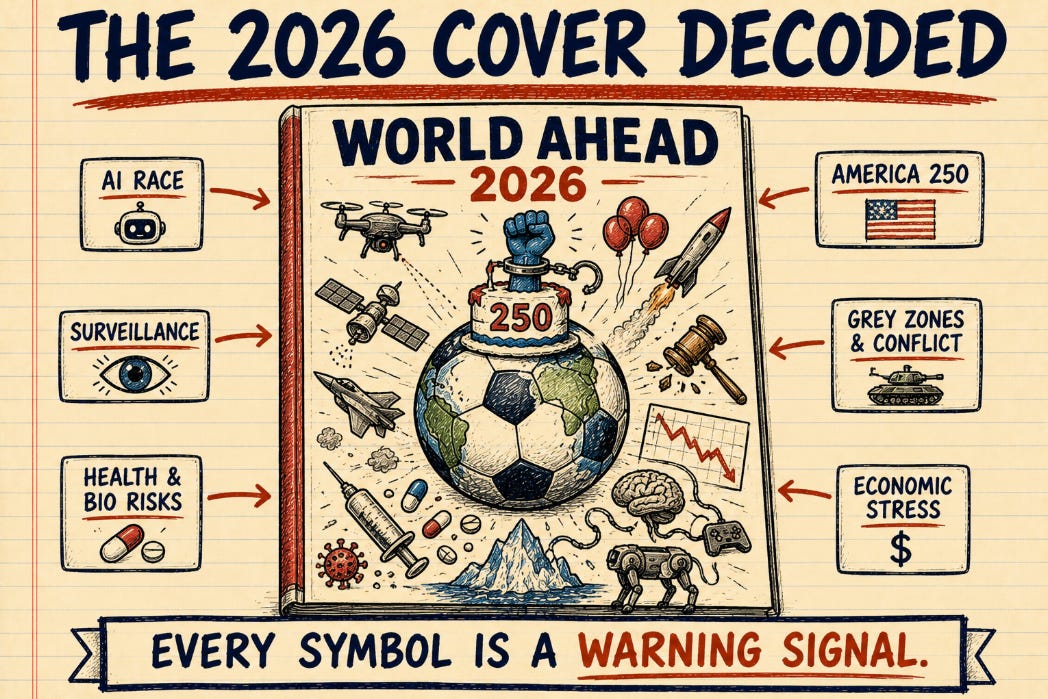
Every November, The Economist publishes a cover so dense with symbolism it launches a thousand conspiracy theories. The 2026 edition (40 years into their predictions practice) is the most analyzed magazine cover of the decade.
The question splitting readers: is it forecast, signal, or something more deliberate?
I’m an AI automation engineer. I read this cover the way I read product diagrams. Every element is there for a reason, and the reasons usually live in the second pass.
After two weeks decoding it, here’s what I found. 2026 isn’t the year the world breaks. It’s the year we discover how it already broke, and the role AI plays in keeping it that way.
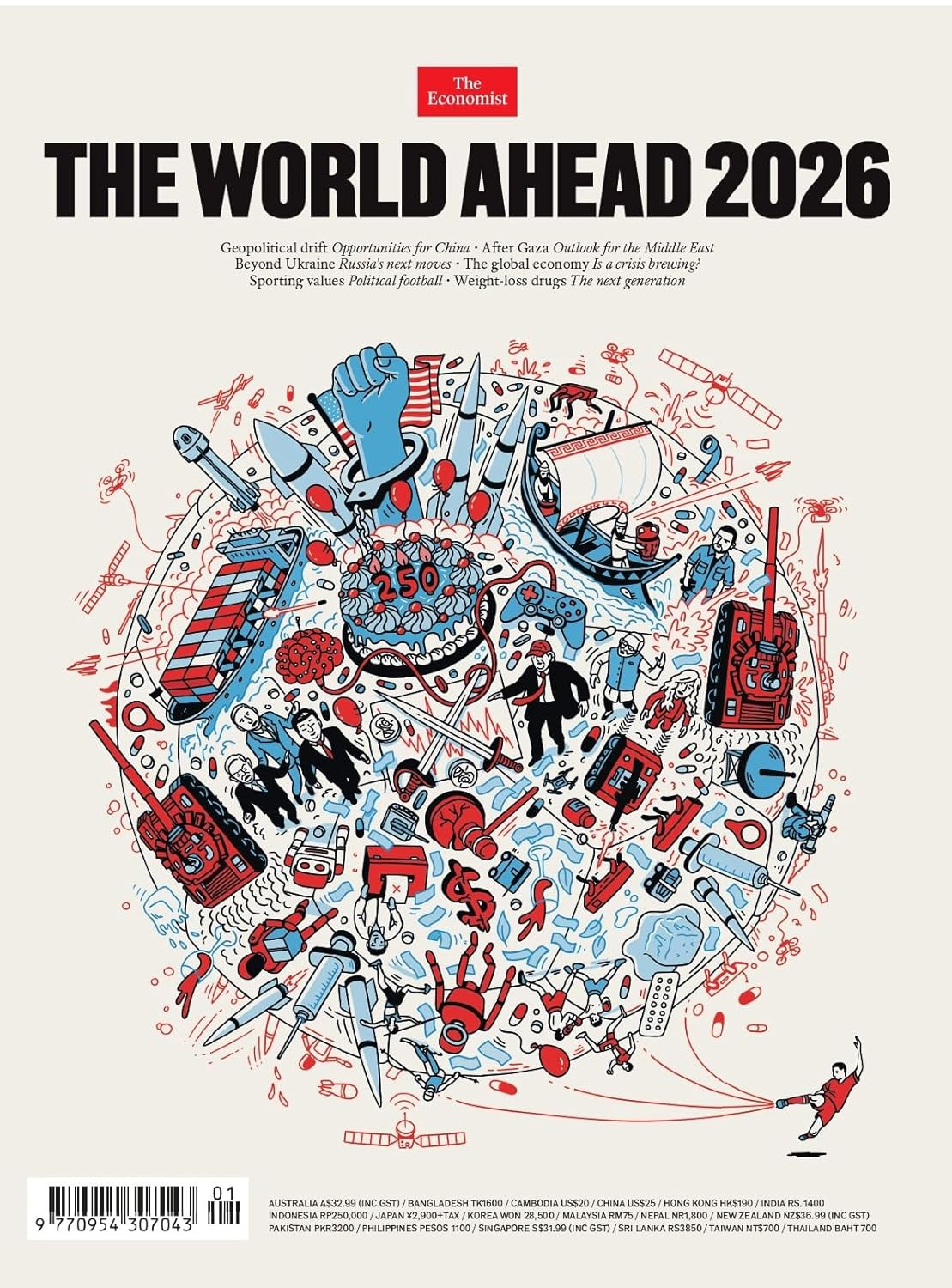
The Cover That Broke the Internet
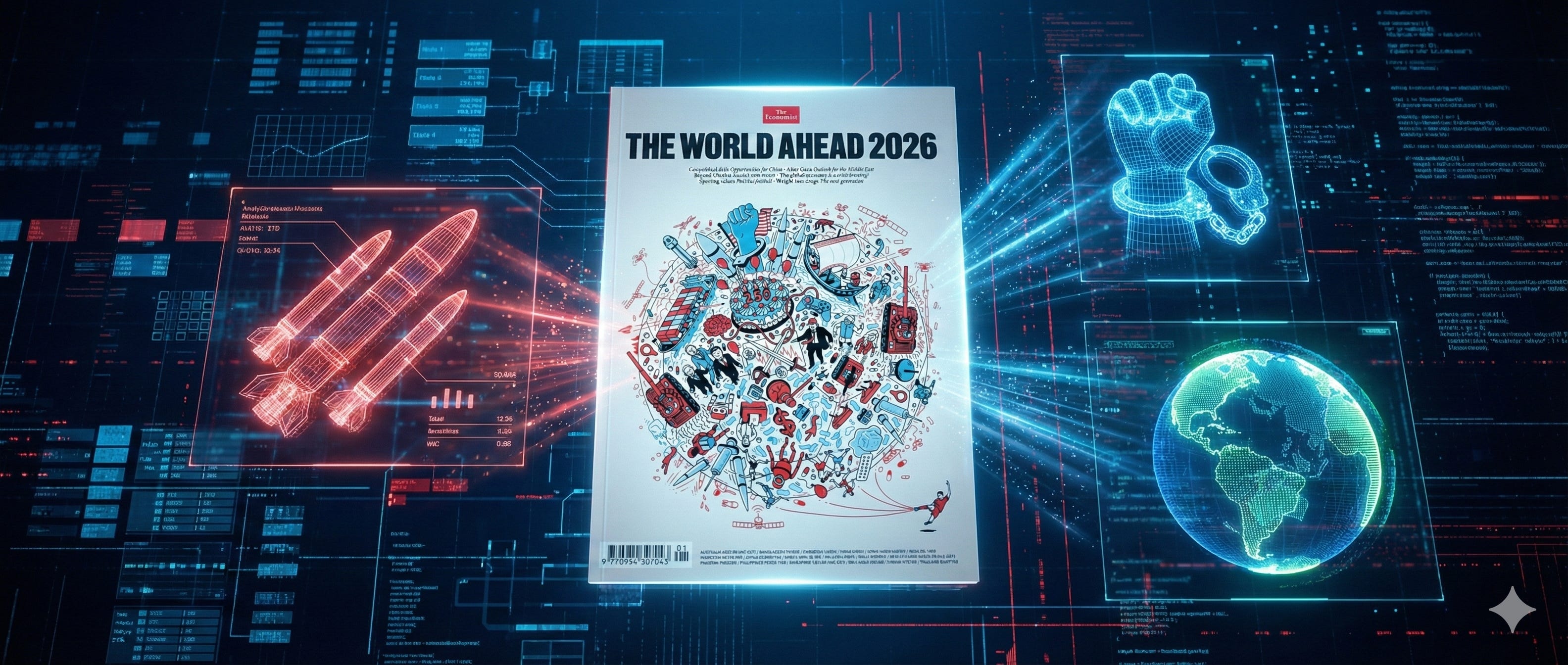
Released November 10, 2025. The Economist’s “World Ahead 2026” cover renders a chaotic planet as a soccer ball, orbiting weapons, pills, surveillance drones, and a birthday cake marked “250.”
Within 48 hours it went viral. Not just in policy circles. Across TikTok, X, and conspiracy forums.
Why the obsession? The Economist isn’t just any magazine. 21% owned by the Rothschild family. Read by every G7 finance minister. When they publish predictions, markets move.
Their Editor-in-Chief attended the 2025 Bilderberg meeting in Stockholm. Their track record is “weirdly accurate.” They correctly predicted 6 of 9 major 2025 events, though they badly underestimated Trump’s 2024 victory (giving him only 33% odds).
But 2026 is different. Editor Tom Standage calls it “a year of uncertainty” where “the old world order is finished.” Not incremental change. Systemic recombination.
And almost every signal on the cover points at one accelerant: AI.
The Visual Grammar: Red vs. Blue, Chaos vs. Control
Start with the color. The cover splits the world into red and blue. That one choice is the geopolitical map.
Blue is the Western order. NATO, tech dominance, the dollar system, democratic institutions. Defensive posture, trying to hold the global chokepoints: SWIFT payments, semiconductor supply chains, shipping insurance.
Red is alarm. Disruption. Conflict. The revisionist powers (China, Russia), inflation zones, hot conflicts.
The interplay isn’t Cold War binary. It’s messier. A nervous system where a shock in one domain transmits instantly across the whole structure.
This isn’t East vs. West. It’s a Standards War. Two competing systems for AI regulation, trade rules, digital currencies, tech ecosystems.
Countries aren’t choosing sides. They’re navigating between two incompatible operating systems.
The 250 Birthday Cake: America’s Divided Jubilee
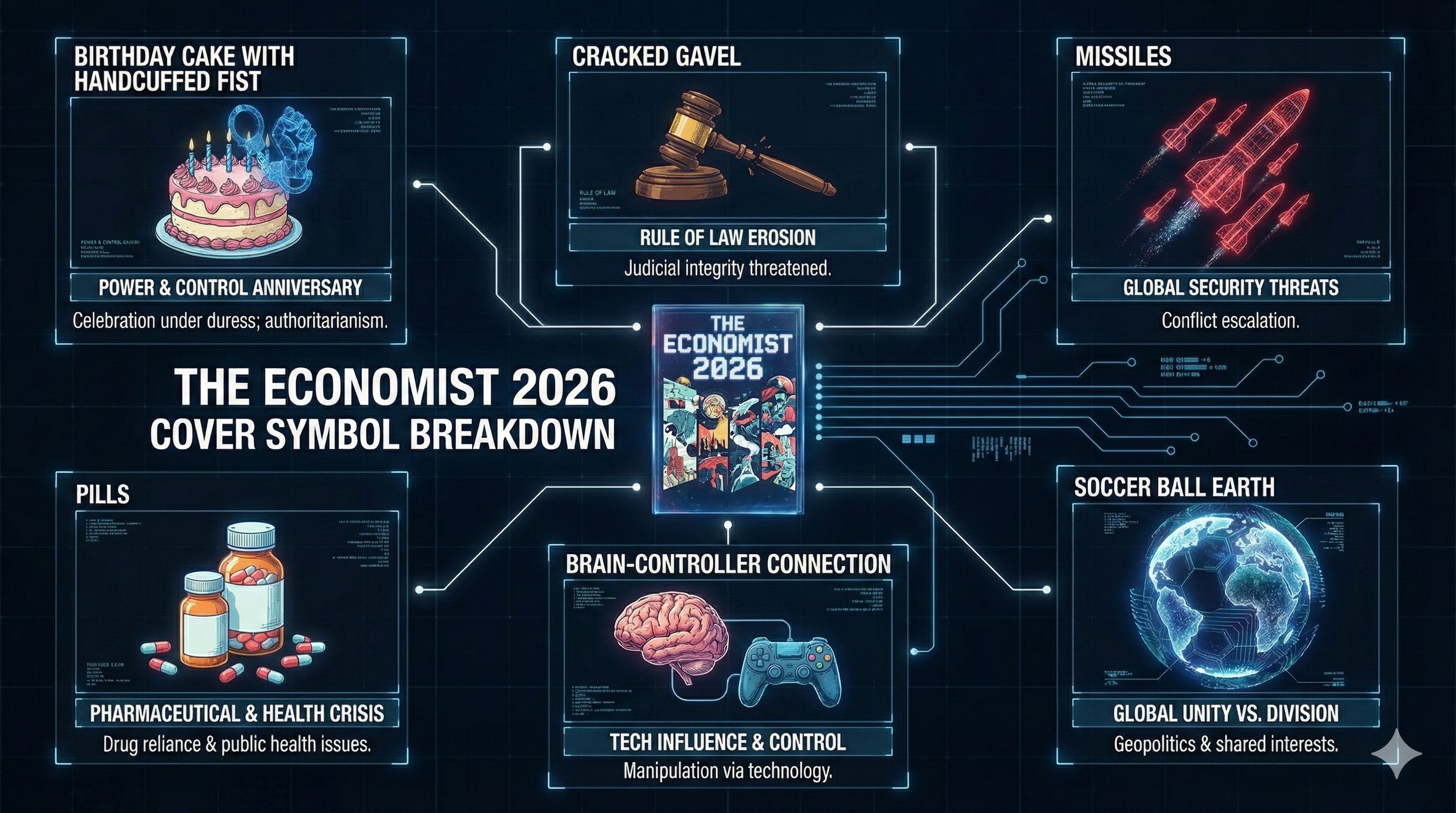
At the center sits a massive cake marked “250.” America’s 250th anniversary on July 4, 2026. Look closer.
Rising from the cake: a blue fist locked in handcuffs. Popular uprising met with authoritarian response. Below it, a cracked judicial gavel signals a fractured justice system. The balloons are red, echoing the 1983 Cold War track “99 Red Balloons” about innocent objects triggering military panic.
The Economist predicts Americans will hear “wildly diverging accounts” of their country. Two competing narratives:
The 1776 narrative (Republican / Trump): founding ideals, nationalism, rejection of “woke” revisionism.
The 1619 narrative (Democrat / progressive): unfinished work of democracy, reckoning with slavery and inequality.
This isn’t just a culture war. It’s a narrative civil war, and AI is the megaphone. Russia and China will amplify the divisions through AI-generated disinformation, deepfake politicians, synthetic protest footage. The 250th anniversary won’t unite America. It will reveal how fractured it already is.
Same week, Philadelphia hosts a FIFA World Cup Round of 16 match. Patriotic spectacle colliding with global sport, with strained relations between the US and co-hosts Mexico and Canada.
The Soccer Ball Earth: When Sport Becomes Warfare
The planet is rendered as a black-and-white soccer ball. Direct reference to the 2026 FIFA World Cup (June 11 to July 19). First 48-team tournament. First three-nation hosting.
The symbolism runs deeper. The world as a ball being kicked around by powerful actors. Geopolitics as competitive spectacle where the referee (international law) has limited authority.
Tourism Economics projects 1.24 million international visitors, 6.5 million total attendees. The Economist warns “fans may stay away” because of political tensions. Trump threatened to remove matches from Democrat-led cities. Even the world’s most unifying event cannot escape geopolitics.
A 48-team tournament at this scale runs on AI infrastructure. Facial recognition, threat detection, drone surveillance, crowd-flow models. The stadium is the surveillance state’s product demo.
This connects to The Economist’s “Sporting Values” theme. Sport no longer offers respite from politics. It IS politics. The shift is from “sportswashing” to sports-warfare, where hosting rights and fan treatment become diplomatic weapons.
Meanwhile, the Enhanced Games debut in Las Vegas (May 2026). Performance-enhancing drugs explicitly permitted. $500,000 purses per event. $1 million for world records. WADA calls it “ridiculous and dangerous.” But it is happening.
Most of those drugs were AI-designed. Modern drug discovery is AI-first. The Enhanced Games is what happens when you stop pretending the AI-pharma pipeline exists.
The question: is enhancement cheating, or just a different game?
This extends beyond athletics. Millions take next-gen GLP-1 weight-loss pills (also AI-discovered). As The Economist notes: “Few people compete in the Olympics, but anyone can take part in the Ozempic games.”
Grey Zone Warfare: The New Normal
The cover bristles with military hardware. White missiles with red tips. Tanks scattered globally. An armed robot dog (direct reference to China’s weaponized dog-like robots deployed in 2023 military drills).
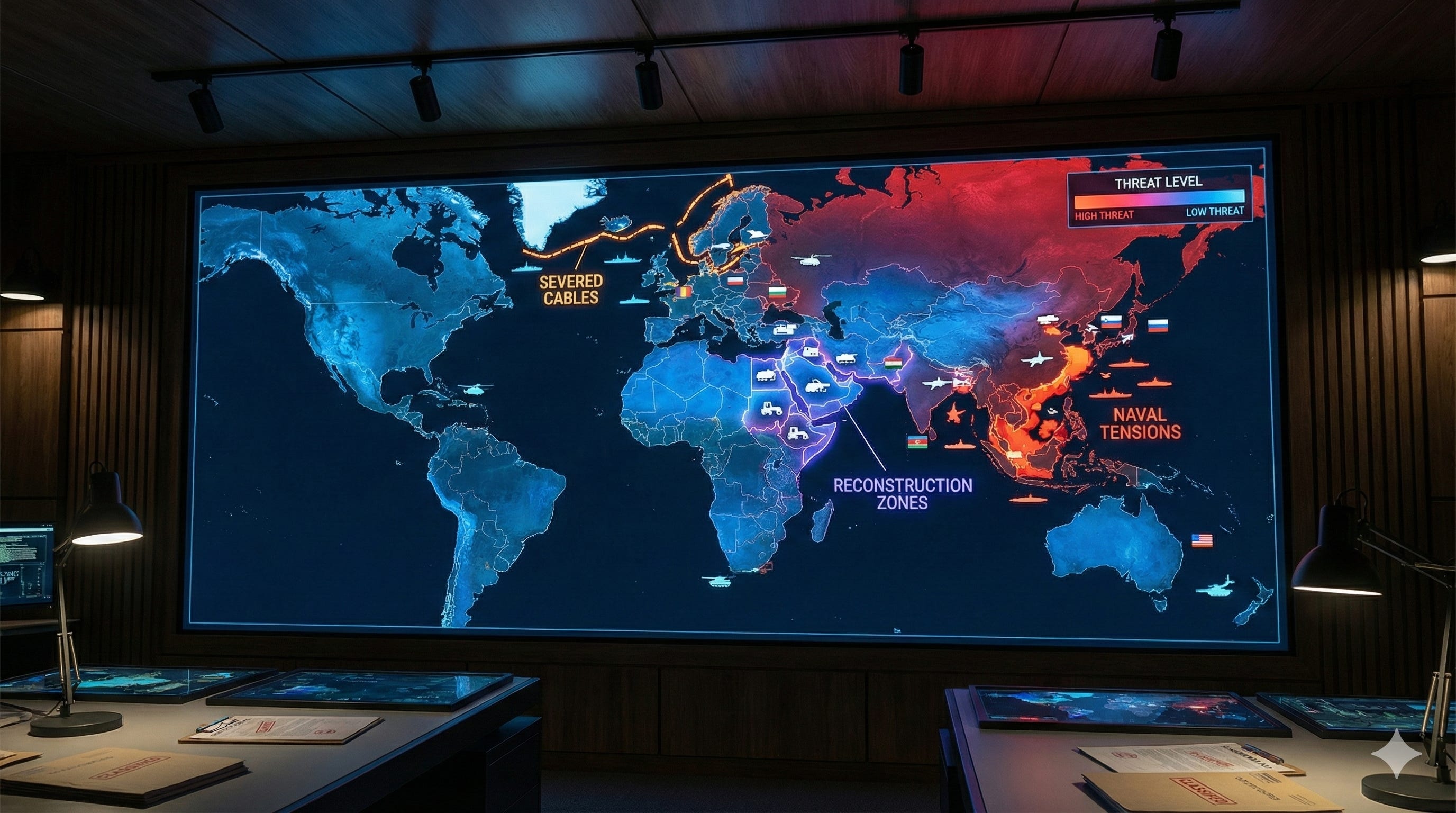
But notice. These aren’t arranged for total war. They’re positioned for perpetual tension.
The Economist predicts 2026 will see “grey zone” provocations. Hostile actions below the threshold of declared war. And the grey zone is where AI changes everything: cheaper, deniable, scalable.
Northern European front
Russia will test NATO commitment through:
GPS jamming affecting civil aviation
“Accidental” severing of undersea fiber-optic cables (seabed warfare)
AI-driven cyberattacks on infrastructure (banks, power grids)
Strategic goal: fracture NATO unity. If a cable is cut and Russia denies it, does NATO invoke Article 5? The ambiguity is the weapon. AI makes the ambiguity cheaper to produce.
South China Sea front
China will test US resolve through:
Maritime militia vessels (fishing boats acting as naval auxiliaries)
Water-cannoning Philippine resupply ships
“Quarantine” blockades of Taiwan
Japan’s Type-12 surface-to-ship missiles extend to 1,000km range by 2026, creating a new deterrent landscape China may test before it is fully operational.
After Gaza, The Iran War, and What The Economist Missed
The cover labeled Middle East “After Gaza.” The thesis: transition from kinetic intensity to fragile diplomacy.
They underestimated how fast the transition would invert.
On February 28, 2026, US and Israeli forces launched Operation Epic Fury. The strike assassinated Iran’s Supreme Leader Ali Khamenei and hit nuclear sites. Iran retaliated with missile and drone strikes on Israel, US bases, and Gulf states. Iran closed the Strait of Hormuz. Global trade choked.
Operation Epic Fury formally ended May 5, 2026. Thousands dead. Millions displaced across Iran, Lebanon, Israel, and the Gulf.
The ceasefire is “indefinite” but fragile. On May 10, Trump rejected Iran’s nuclear proposal. Iran’s military warned of “new arenas of war.” Drones tested the ceasefire the same day off Qatar, with airspace incursions into UAE and Kuwait.
The new power center inside Iran is IRGC Commander Maj. Gen. Ahmad Vahidi, the de facto successor to Khamenei. He is the hardliner blocking concessions on the Strait of Hormuz and Iran’s HEU stockpile. The US is pushing a one-page MoU. Iran is stalling.
Russia is rebuilding Iran’s capacity during the ceasefire. Drone components arrive via the Caspian Sea. During the war, Russia and China shared satellite imagery of US bases with Iran. The “Standards War” of the cover is now a kinetic alliance.
Iranian-backed Iraqi militias (Kataib Hezbollah, Hezbollah al Nujaba, Kataib Sayyid al Shuhada) refuse to disarm. The 2026 Iran war ended on the calendar, not on the ground.
What the cover got right: the militarization. The robot dog. The missiles with red tips. The Standards War. The Russia-China alignment.
What it missed: the speed. The assassination of a head of state. The Strait closure. The scale of displacement. The Economist projected a “Trumpian deal” for Saudi-Israel normalization. There has been no deal. There has been a war.
The accelerant the cover did not name: AI-targeted drones, AI-analyzed satellite intel from Beijing, AI-enhanced naval logistics in the US blockade. The cover showed surveillance. It did not show that the surveillance had already gone autonomous.
The Brain and the Controller: Cognitive Warfare
The cover’s most dystopian image is the simplest. A human brain wired to a video game controller.
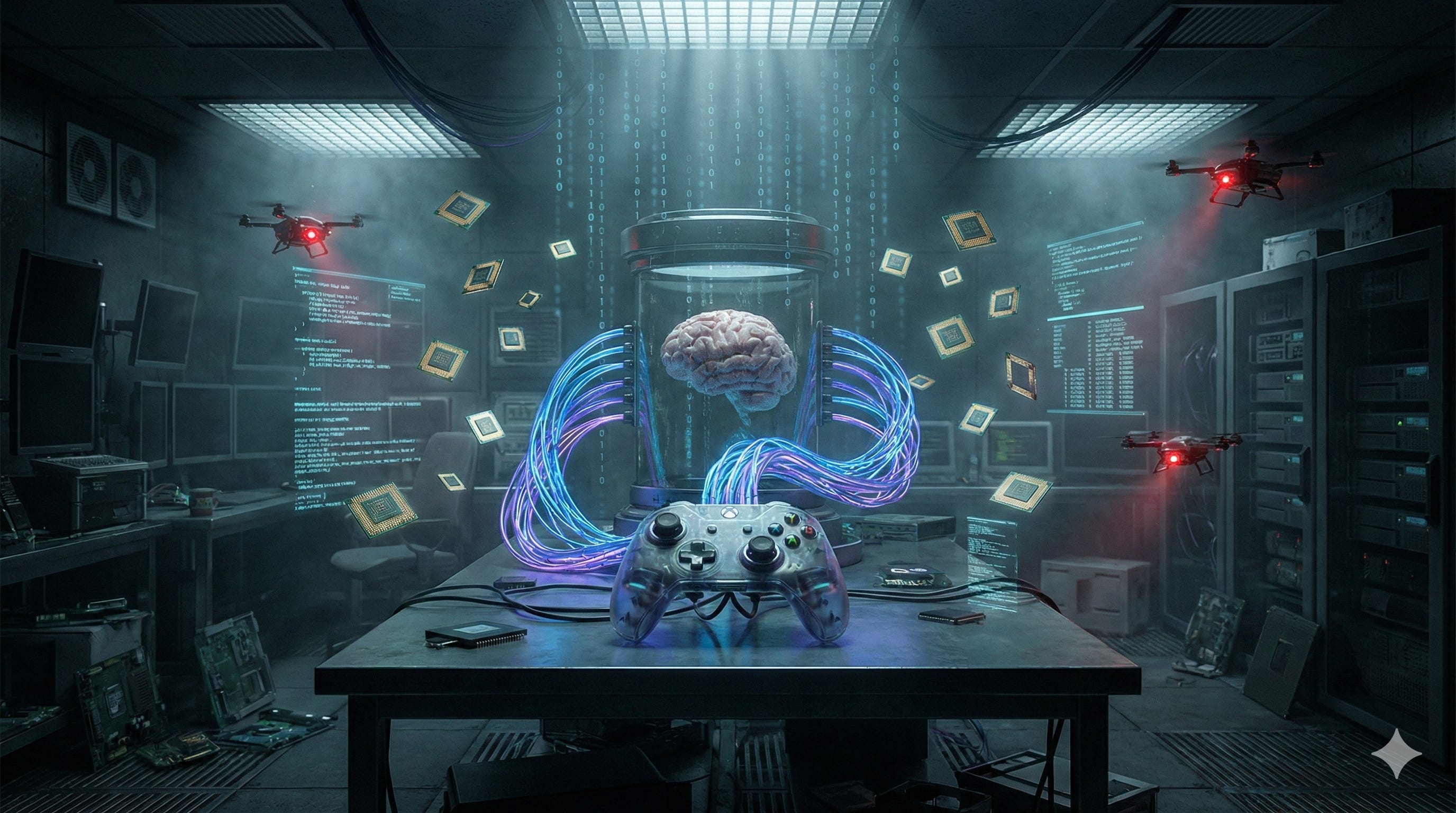
It reads two ways at once.
Technological. Neuralink brain-computer interfaces enter clinical trials. 2026 is the year biology and silicon start sharing wire.
Sociological. This is cognitive warfare. The US 250th anniversary and November midterms make 2026 a year when the “public mind” becomes the contested terrain. Political narratives play out like video games. Recommendation algorithms are the controllers. Human sentiment is the score.
The battlefield of 2026 isn’t just land or sea. It’s the neuro-circuitry of populations.
Gartner predicts 40% of enterprise applications will run task-specific AI agents by 2026, up from under 5% in 2025. But Nobel laureate Daron Acemoglu warns: “These models are being hyped up, and we’re investing more than we should.”
The Economist asks bluntly: “Will the AI bubble burst?”
By 2026, trillions will have been spent on AI infrastructure: chips, data centers, energy. Investors will demand tangible ROI. If AI hasn’t delivered productivity gains, funding could evaporate, triggering a tech crash on the scale of the 2000 dot-com burst.
The energy constraint is real. Data centers consume more electricity each quarter, forcing a pivot back to nuclear or fossil fuels, colliding directly with climate goals.
Economic Gravity Returns: The Bond Market Reckoning
A plunging red line graph with scattered US pennies appears prominently. The Economist’s warning: “rich countries are living beyond their means.”
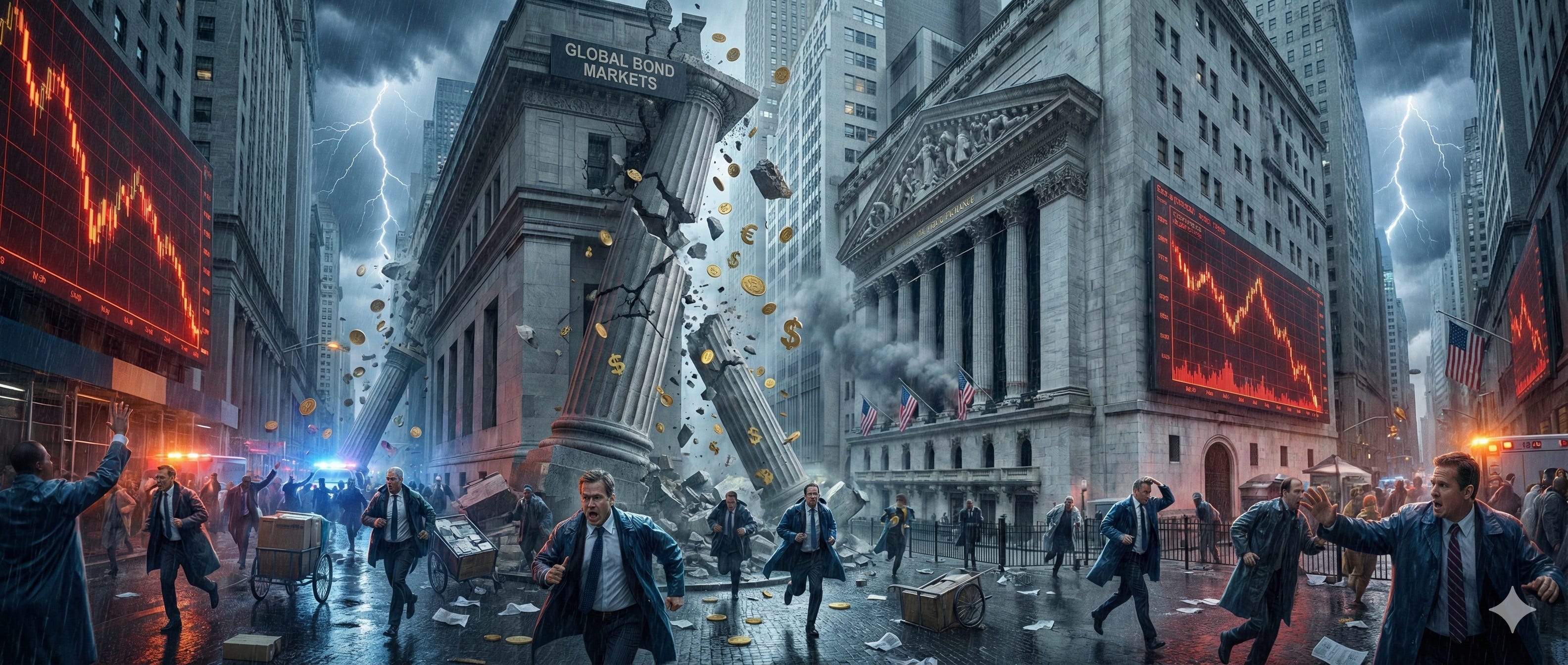
The bond vigilante scenario
G7 governments ran massive deficits for pandemic relief, wars, and industrial policy. AI capex added trillions on top. In 2026, the bill comes due.
“Bond vigilantes” (investors who sell government debt to protest fiscal irresponsibility) may return, driving up yields. This crushes government budgets as debt service costs soar. It also crushes mortgage holders.
The choice becomes brutal:
Austerity: cut spending (risks recession and unrest)
Financial repression: let inflation run hot to erode debt
J.P. Morgan assigns 40% probability to a US or global recession. Fed Chair Jerome Powell’s term ends May 2026. Politicizing the Fed seat could trigger a market showdown.
Trump’s tariffs will “dampen global growth,” eventually biting consumers with stagflationary pressure.
China’s deflationary trap
China faces its own crisis: deflation, industrial glut, demographic decline. Goldman Sachs projects 4.3 to 5.0% GDP growth. But the strategy of “exporting its way out” by flooding the world with cheap goods will trigger retaliatory tariffs from the US and Europe.
The crisis creates opportunity. As the US turns inward (”America First”), China consolidates the Global South. Latin America, Africa, Southeast Asia. China presents itself as the “adult in the room,” offering trade agreements and green tech dominance: EVs, solar, batteries. All AI-optimized supply chains. Bangladesh is explicitly targeted for engagement with lower-interest loans.
The Pharmaceutical Revolution: Syringes, Pills, and the Supply Chain of Thinness
Giant hypodermic needles and scattered pills dominate the cover. The Economist’s tenth theme: “Ozempic, but better.”

Next-gen GLP-1 weight-loss drugs arrive in pill form in 2026. Eli Lilly’s orforglipron targets spring FDA approval at $149-150 per month (vs $1,000+ for current injectables). Novo Nordisk slashed prices 70%. Generic versions launch in Brazil, China, India. The global market surpassed $26 billion in 2025 and explodes from there.
The economic earthquake
This isn’t just healthcare. It’s macro-economic disruption.
“Big Junk” food industry faces existential threat. As caloric intake drops globally, Nestlé, PepsiCo, McDonald’s see shrinking markets. Investors may short these stocks while going long on pharma giants.
Healthcare systems face upfront cost explosions despite long-term savings from reduced diabetes and heart disease.
The ethics debate: “Is taking them cheating?” The question extends from athletes to everyday people. Are we hacking our metabolism or addressing a health crisis?
The other syringe: pandemic stockpile
The syringes next to missiles aren’t coincidence. Pharmaceutical supply chains are now national security, and 2026 is testing them on two fronts at once.
H5N1 avian flu has 71 US cases since 2024, 43 mammal species infected, one US death in Louisiana, one child fatality in Bangladesh (January 2026), and one British Columbia case with no identified exposure source (March 2026). WHO tracked 13 zoonotic flu variant cases in Q1 2026. No sustained human-to-human transmission yet. The “yet” is doing a lot of work.
AI-discovered antivirals, AI-screened pathogens, and AI-monitored wildlife genomic surveillance are now the default pipeline for pandemic preparedness. The same AI-pharma stack that produced cheap GLP-1 pills is the stack racing the next outbreak.
The cover shows the syringe as a symbol of societal transformation and geopolitical positioning. The same syringe is the front line of biosecurity.
Surveillance Omnipresence: The Transparent Battlefield
The cover swarms with drones and satellites. They visualize the “panopticon” state where privacy is extinct.
The end of privacy. Surveillance spans urban centers to the remote Arctic. Every cable, every ship, every movement is monitored. The panopticon only works at this scale because AI does the watching now. Humans do not review feeds. Models do.
Orbital warfare. These symbols warn of grey-zone provocations in space. Expect satellite dazzling, cyber-hijacking of constellations, militarization of commercial assets like Starlink. The eyes are watching. They are also targets.
The broader theme: 2026 is the year of the “Transparent Battlefield.” Advantage goes to those who see first, decide fastest, and act before the other side has processed the same data. That is an AI workload, not a human one.
The European Trilemma: An Impossible Balancing Act
The Economist identifies “Problems for Europe” as a top theme. The continent faces a mathematical impossibility:
Increase defense spending (to deter Russia)
Maintain social welfare (to appease voters)
Reduce deficits (to please bond markets)
It cannot do all three.
Austerity drives voters toward anti-establishment parties threatening Euro / NATO exit. That creates an existential crisis for the EU project. The hard-right populism surge becomes the engine of political instability.
Yet opportunity exists. Defense industry renaissance. Leadership in AI regulation through the AI Act, which has become the global benchmark for governance frameworks while Washington stalls and Beijing builds its own.
Regional Outlook: The Strategic Map of 2026
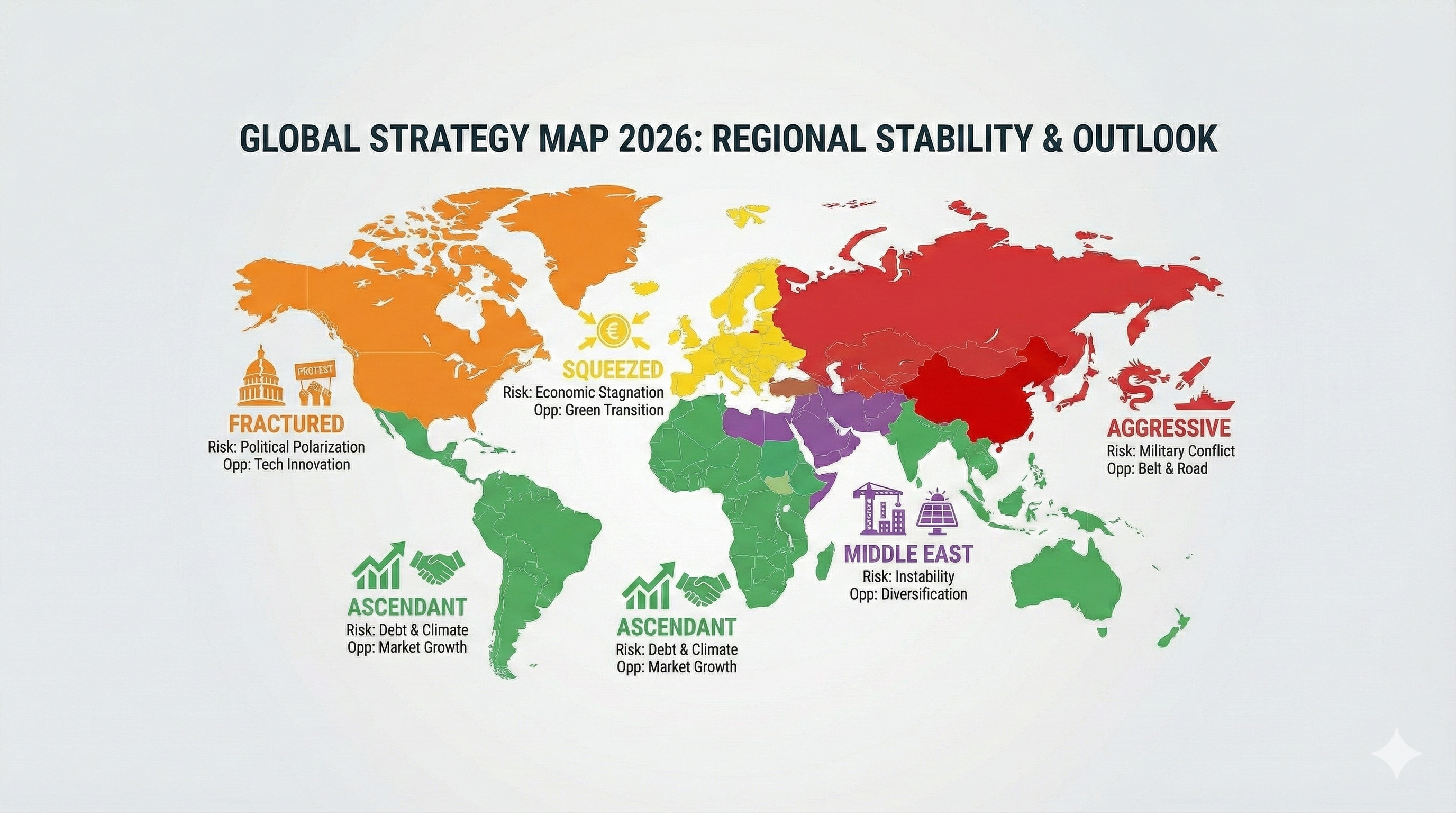
Climate’s Mixed Picture: Green Hushing
The cover shows melting ice cubes. A nod to climate crisis. The Economist’s verdict: 1.5°C warming target is “off the table.”
But here’s the twist: “Green Hushing” emerges as corporate strategy. Companies keep decarbonizing, not for ideology but because solar and wind are now cheaper. They stop talking about it to avoid anti-ESG backlash in Trump’s America.
Meanwhile the Global South accelerates adoption, aided by Chinese tech. The “Green” mantle passes from West to developing world. The moral center of gravity in geopolitics shifts with it.
Geothermal energy emerges as the sector to watch. AI data centers need 24/7 baseload power that solar and wind cannot match. Geothermal can. The energy transition is now downstream of the AI capex cycle.
The Conspiracy Layer: Predictive Programming or Pattern Recognition?
No analysis is complete without addressing the elephant in the room: conspiracy theories.
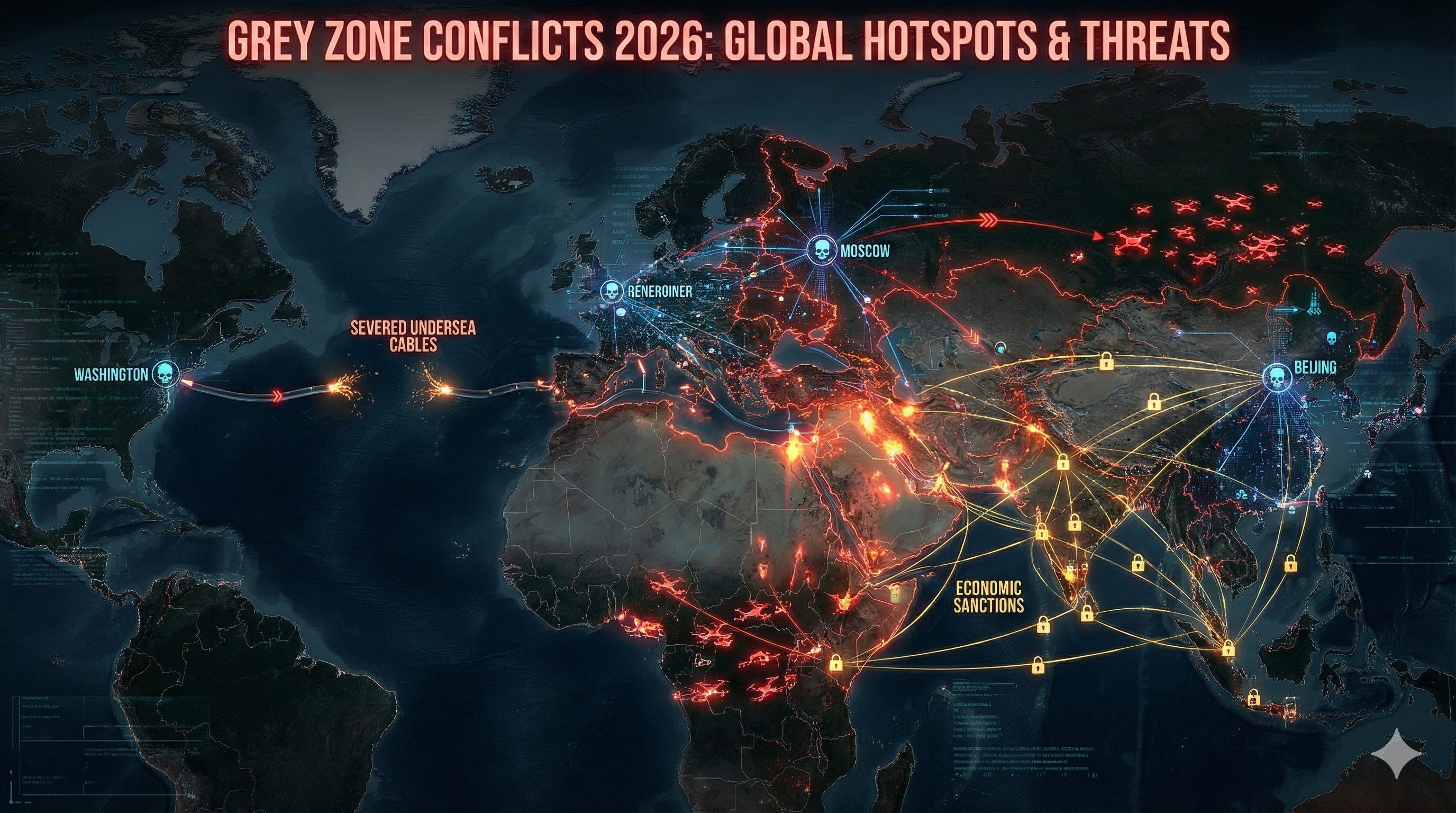
Within days of release, alternative media exploded with “decoding” content. Key narratives:
The Rothschild-Bilderberg theory. With 21% Rothschild ownership and the Editor-in-Chief attending Bilderberg, conspiracists frame the predictions as elite communication, not analysis.
The Illuminati / 1776 connection. 1776 marked both US independence and the Bavarian Illuminati founding. The cake is read as “alluding to elite secret agendas.”
The “Plandemic” interpretation. Prominent syringes signal another health crisis. Marburg virus fears dominate this thread.
The mind-control theory. The brain-controller represents mass psychological manipulation via AI. This one is less conspiracy and more current operating reality of every social platform you use.
The Economist has leaned into the speculation, admitting they include “mysterious symbols or red herrings to keep conspiracists guessing.”
But here is the reality. Elite forecasters report 53% confidence but achieve only 23% accuracy (Berkeley Haas study). Fed research shows professional forecasts perform no better than benchmarks at one-year horizons.
The pattern. The Economist excels at identifying which issues will dominate discourse. Call it a trend compass. They struggle with specific outcomes, timing, and black swans.
Use these predictions as a framework for understanding what sophisticated analysts consider important, not as prophecy.
What Actually Happens in 2026: The Scheduled Events
Beyond predictions, here is what is confirmed:
February 6-22: Milano Cortina Winter Olympics (debuts ski mountaineering)
February 8: Super Bowl LX at Levi’s Stadium
February 2026: Artemis II, first crewed lunar mission since 1972 (NASA budget concerns may delay)
June 11 - July 19: FIFA World Cup (48 teams, 16 US cities)
July 4: US 250th anniversary. Time capsule burial in Philadelphia. 7th International Fleet Review (60 ships, 30 countries). MLB All-Star Game
November 3: US Midterm Elections (Democrats need net +3 for House majority; historical trends favor opposition. AI-generated deepfake interference is the wildcard)
The Meta-Narrative: From Globalization to Game Theory
The synthesis of all this research reveals a profound shift.
We are moving from the era of “Globalization” to the era of “Game Theory.”
Relationships are transactional, strategic, zero-sum. The distinction between a trade deal and a peace treaty has vanished. Sport, health, technology, finance: all are now weapons in a single arena of competition.
The “nervous system” metaphor is perfect. A shock anywhere transmits everywhere. A tariff tweet in Washington affects chip supply in Taiwan, energy prices in Europe, bond yields in Japan.
The old world order is not dying. It is already dead. 2026 reveals what replaces it: fluid “coalitions of the willing,” competing tech standards, weaponized commerce, grey-zone conflicts where ambiguity is the strategy.
And one operating system running underneath all of it: AI.
Conclusion: Watch the Grey Zones
The Economist’s 2026 cover functions as visual information density. Too many crises to isolate, too interconnected to separate. Earth as a soccer ball orbited by weapons, pills, and surveillance while a divided America celebrates: festivity amid fragility.
The lasting value is not predictive accuracy (which will be mixed). The value is the identification of forces competing for attention. A birthday party held on a soccer ball surrounded by missiles and pills, with a handcuffed fist emerging from the cake. That is the visual thesis.
Same exercise I ran last year on the 2025 cover. The framework holds. The threat surface widened.
Here is your action framework for 2026:
1. Watch the grey zones
The next crisis will not start with a declaration of war. It will start with a severed cable in the North Sea, a “quarantine” of Taiwan, or a quiet bond market default.
2. Follow the money and the medications
The GLP-1 revolution will reshape economies faster than AI. Short junk food, long pharma, and watch for healthcare cost explosions.
3. Understand cognitive warfare
Elections, narratives, and public opinion are the battlefield. Algorithms are the weapons. Your attention is the territory.
4. Embrace transactionalism
Permanent alliances are over. Success goes to those who can play multiple sides without commitment.
5. Prepare for volatility
2026 is not the year the world breaks. It is the year we discover how it already broke and learn to navigate the fragments.
Navigating fragments is now a tooling problem. You need a personal system that captures, connects, and surfaces what matters before the next signal arrives. That is exactly what obsidian-second-brain was built for, and why I built it for myself.
In 2026 the future arrives. Not as shiny utopia. As gritty reality of AI surveillance, bio-hacked bodies, and drone warfare. Everything is connected. Everything is at risk.
The question is not whether The Economist’s predictions come true. The question is whether you are ready for a world where they are even plausible.
Your Turn: What Do You See?
I’ve decoded what five AI systems and dozens of analysts found in this cover. But symbols are Rorschach tests. They reveal as much about the observer as the observed.
What patterns do you see emerging? What am I missing?
Drop your analysis in the comments. Let’s build a collective intelligence network that rivals any think tank.
If you found this useful, subscribe to The AI Operator. One post per week. AI agent patterns, Obsidian + AI workflows, and the geopolitical context of the technology shaping 2026.
Clarity is the only competitive advantage left.
Sources
The Economist, “The World Ahead 2026” (November 2025)
Berkeley Haas Business School, “Elite Forecaster Accuracy Study”
J.P. Morgan Global Economic Research
Goldman Sachs China Economic Outlook
Gartner AI Adoption Forecasts
Tourism Economics FIFA World Cup Impact Analysis
Institute for the Study of War, Iran Update Special Reports (May 2026)
CDC A(H5) Bird Flu Situation Summary
WHO Q1 2026 Zoonotic Influenza Report via CIDRAP