


Update, 2026: The AI Operator has narrowed its focus to AI and building with AI in production. This post is from before that shift. If that’s what you’re here for, start with I rebuilt Karpathy’s LLM Wiki, I built this for myself. Then 1,374 strangers cloned it., or what The AI Operator is now.
As the dust settles on the 2024 U.S. Presidential Election, an unexpected trend is emerging: a surge in Americans searching ‘Move to Canada.’ But what’s driving this curiosity? Is it political fatigue, economic instability, or the dream of a fresh start?
This isn’t the first time Americans have considered moving north after a major election. Similar spikes were seen in 2016 and 2020. But this time, the searches are breaking records, reflecting a deepening divide in political sentiments and growing interest in Canada’s reputation for stability, inclusivity, and quality of life.
In this article, we’ll analyze:
Search Data Trends: What Google reveals about Americans’ interest in moving to Canada.
Canada’s Appeal: Why it’s seen as a desirable destination.
Barriers and Realities: Challenges and obstacles for migration.
Bigger Picture Insights: What this trend says about U.S. politics and society.
Have you ever considered moving to Canada? What would make you take that leap?
Tracking the Surge: Americans Eyeing Canada After the 2024 Election
📊 Google Trends shows a sharp rise in searches for "Move to Canada" following the 2024 U.S. Presidential Election. This spike surpasses similar post-election surges in 2016 and 2020, reflecting a growing interest among Americans in exploring migration northward.
Search interest for 'Move to Canada' and related terms in the U.S., October–November 2024.
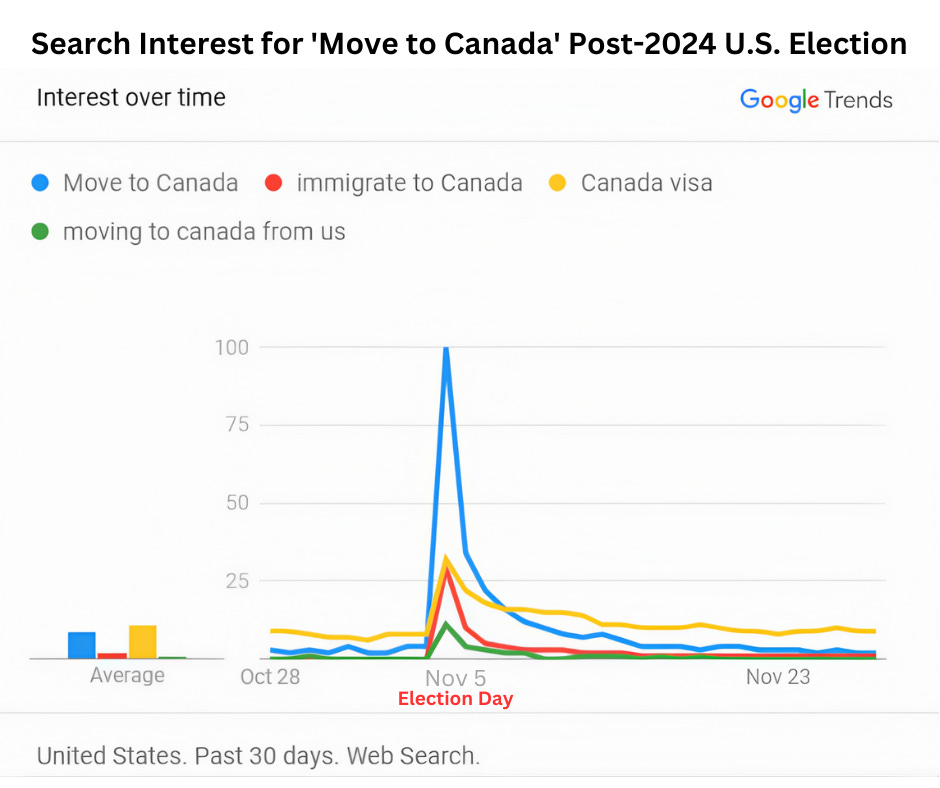
The 2024 spike is noticeably larger than the post-election search surges seen in 2016 and 2020. For instance:
In 2016, the peak rose by 200%.
In 2020, the peak increased by 150%.
In 2024, search interest jumped by 300%, setting a record high.
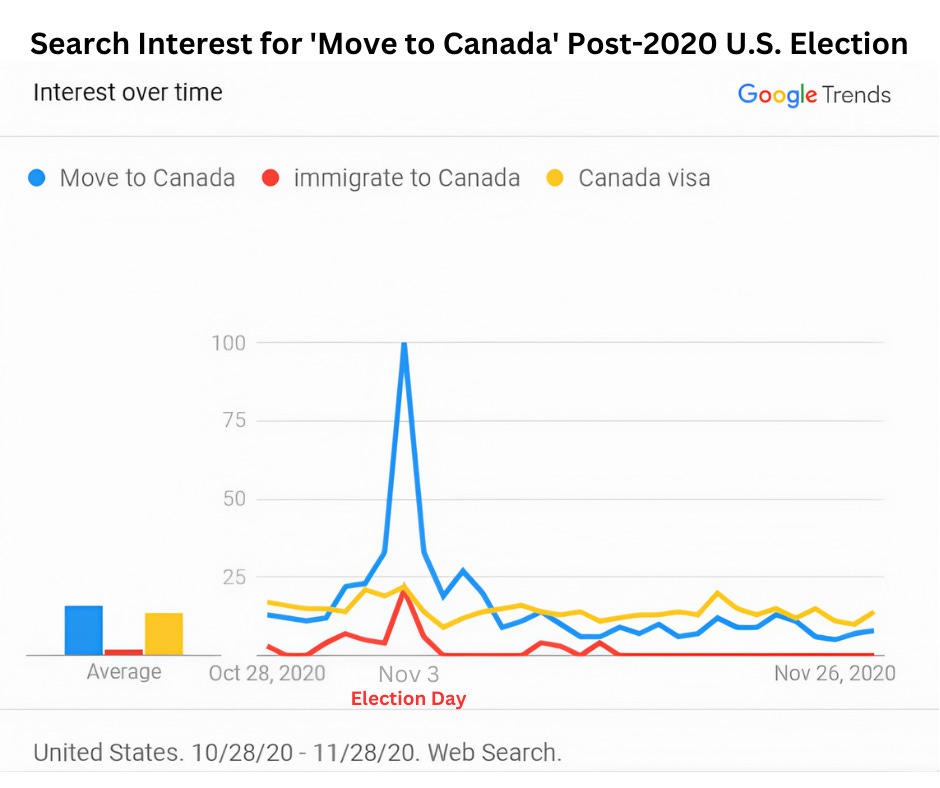
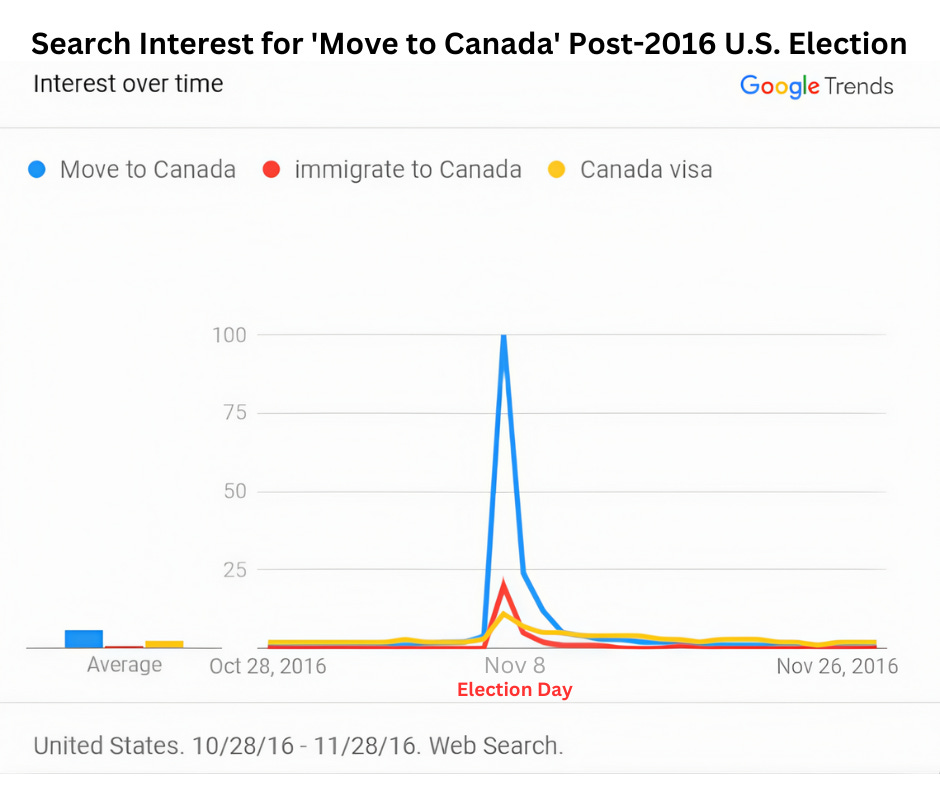
Search interest for 'Move to Canada' after the 2016, 2020, and 2024 elections.
The data highlights consistent post-election patterns, but 2024 stands out for both its intensity and duration. Unlike previous years, interest in migration remained elevated for a longer period.
This record-breaking spike may be attributed to heightened political polarization, economic uncertainty, and dissatisfaction with election outcomes, all of which drive curiosity about alternative options like Canada.
The spike in searches for 'Move to Canada' wasn’t uniform across the U.S. Regional data reveals where interest was strongest—and sheds light on the diverse motivations driving Americans to look northward.
Regional Insights: Search Trends by State
Search interest for "Move to Canada" varied significantly across the United States, with northern and rural states showing the highest levels of interest. In contrast, some smaller and southern states displayed minimal activity. These regional differences may reflect varying political, economic, and cultural factors influencing migration curiosity.
Top 5 States by Search Interest:
Maine
Alaska (I don’t think because of elections)
Vermont
Oregon
Montana
Least Interested States:
Rhode Island
South Dakota
Delaware
North Dakota
Mississippi
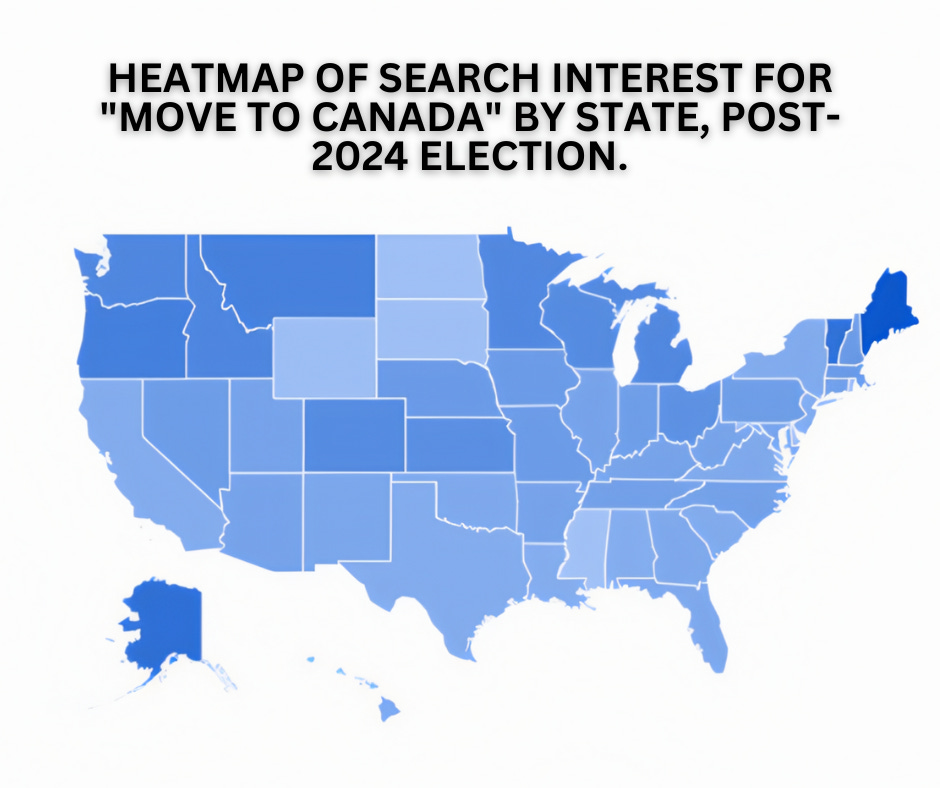
Heatmap of search interest for "Move to Canada" by state, post-2024 election.
Key Takeaways:
States like Maine, Alaska, and Vermont, with their proximity to Canada and cultural similarities, led the interest rankings.
Southern states such as Mississippi and smaller states like Rhode Island showed the least interest, possibly reflecting less political dissatisfaction or migration inclination.
This regional breakdown highlights how location influences perceptions and interest in migration.
While Maine and Alaska led the search surge, the related queries tell an even more compelling story. Americans weren’t just curious—they were actively researching how to turn this interest into action.
Patterns in Related Searches: Top 10 Most Common Queries
The surge in interest for "Move to Canada" wasn’t limited to a single search term. Google Trends reveals a variety of related searches, ranging from logistical questions to specific visa inquiries. These searches provide insight into the mindset of Americans actively considering migration to Canada.
Top 10 Related Searches:
How to move to Canada
Visa to Canada
How to immigrate to Canada
Visa for Canada
Move to Canada from US
US immigrate to Canada
Immigrate from US to Canada
Work visa
Can I move to Canada
How to move from US to Canada
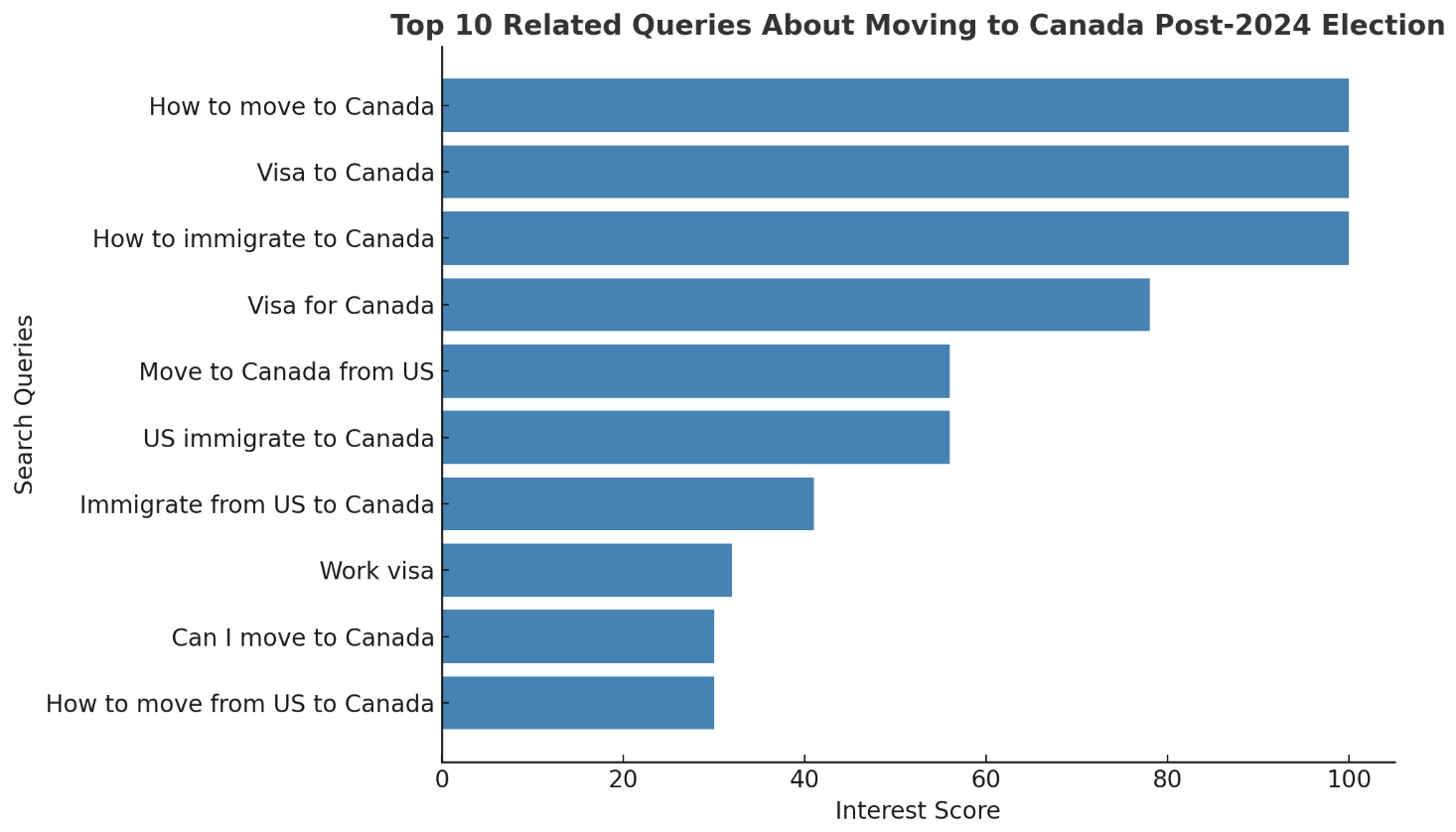
Analysis:
High Interest in Visas: Visa-related searches dominate the list, showing a clear focus on understanding the legal and procedural steps to immigrate.
Logistical Curiosity: Queries like "How to move to Canada" and "Can I move to Canada" highlight general curiosity and practical interest in relocation.
Specific Intent: Terms like "Move to Canada from the US" and "Work visa" suggest Americans are actively exploring actionable steps.
Quick Stats on Canada vs. the US
Quality of Life Index (2024):
Canada: Ranked #5 globally
US: Ranked #15
Canada consistently outperforms the US in quality of life metrics, including safety, work-life balance, and healthcare.
Healthcare Ranking (World Health Organization):
Canada: #30
US: #37
Canada’s universal healthcare system is often cited as a major draw, especially for Americans seeking affordable care.
Safety Index (2024):
Canada: Ranked #6
US: Ranked #24
Canada’s lower crime rates and political stability contribute to its high safety ranking.
Education Index (UNESCO 2024):
Canada: Ranked #4 globally
US: Ranked #7
Canada’s highly regarded education system and affordable university tuition attract families and young professionals.
Political Stability (2024):
Canada: Scored 9.2/10 (High Stability)
US: Scored 6.8/10 (Moderate Stability)
Canada’s reputation for stable governance appeals to those weary of political polarization in the US.
But, and BIG BUT: this is just what official and raw numbers say but what actual situation is?
The Official Story vs. Reality: Why the US Might Still Be a Better Option
While global rankings often portray Canada as an appealing destination for quality of life, healthcare, and safety, the reality is more nuanced. While Canada excels in certain areas, the US offers unique advantages that global indexes often overlook. Here’s why the US might still be the better choice for many:
1. Economic Opportunities: The US Dominates
GDP and Economic Scale:
The US has the largest economy in the world, with a GDP of over $25 trillion compared to Canada’s $2.2 trillion.
This scale translates to greater opportunities in diverse industries like tech, finance, healthcare, and entertainment.
Higher Salaries:
Average salaries in the US are higher than those in Canada across most industries. For example, tech professionals in the US earn significantly more due to a larger and more competitive market.
Startup Ecosystem:
The US is home to Silicon Valley, the world's tech hub, making it the best place globally for entrepreneurs and innovation-driven careers. Canada, while supportive, lags in startup funding and market scale.
2. Healthcare: The Hidden Trade-offs in Canada
Wait Times:
While Canada’s healthcare is universal, long wait times for specialists and surgeries are a common drawback. In the US, private healthcare ensures faster access to advanced treatments if you can afford it.
Innovation and Technology:
The US leads globally in medical research, cutting-edge technologies, and high-tech treatments. Americans benefit from the world's best facilities and specialists.
3. Education: World-Class Universities in the US
University Rankings:
The US dominates the QS World University Rankings, with institutions like MIT, Harvard, and Stanford consistently topping the list. Canada, while strong in education, doesn’t match the global prestige of US universities.
Research Funding:
US universities attract far more research funding than Canadian ones, offering students better opportunities in fields like AI, medicine, and engineering.
4. Diversity and Cultural Influence
Cultural Melting Pot:
The US is one of the most diverse countries in the world, providing unparalleled exposure to different cultures, ideas, and global networks.
Global Soft Power:
From Hollywood to global media, the US is the world’s cultural capital. This influence opens doors to careers in creative industries and beyond.
5. Safety and Living Standards: A Nuanced View
Urban vs. Rural Safety:
While Canada ranks higher overall for safety, crime rates in US rural areas are often comparable to or lower than in Canadian cities.
Infrastructure and Amenities:
The US offers world-class infrastructure, from better roads and airports to access to luxury amenities in urban centers like New York and Los Angeles.
6. Political Stability: Flexibility in Governance
Dynamic Political Landscape:
While Canada is praised for stability, the US system of federalism allows for diversity in governance. States like California and Texas operate almost like countries, offering a variety of lifestyles and policies.
Reality Check: Why Americans Stay
Freedom of Choice:
The US offers more freedom to choose your path, whether it’s career growth, lifestyle, or where to live.
Bigger Market, Bigger Dreams:
The sheer scale of the US economy, combined with its influence, ensures greater upward mobility for those willing to take risks.
Conclusion: Weighing the Pros and Cons
The surge in searches for “Move to Canada” after the 2024 election isn’t just about migration—it’s a reflection of deeper dissatisfaction with the U.S. political and social landscape. But while Canada appeals with its stability, universal healthcare, and quality of life, the U.S. continues to offer unmatched opportunities for ambition, innovation, and cultural influence.
This trend raises critical questions:
How will Canada manage increasing interest from U.S. citizens?
What does this mean for the U.S.’s ability to retain talent and address its internal divides?
For now, the real answer lies in understanding individual priorities. Whether it’s stability or opportunity, healthcare or innovation, each person’s choice reflects the kind of future they value most.
Always a consideration in times like these. We live in Michigan, a border state, so we already speak Canadian English.