


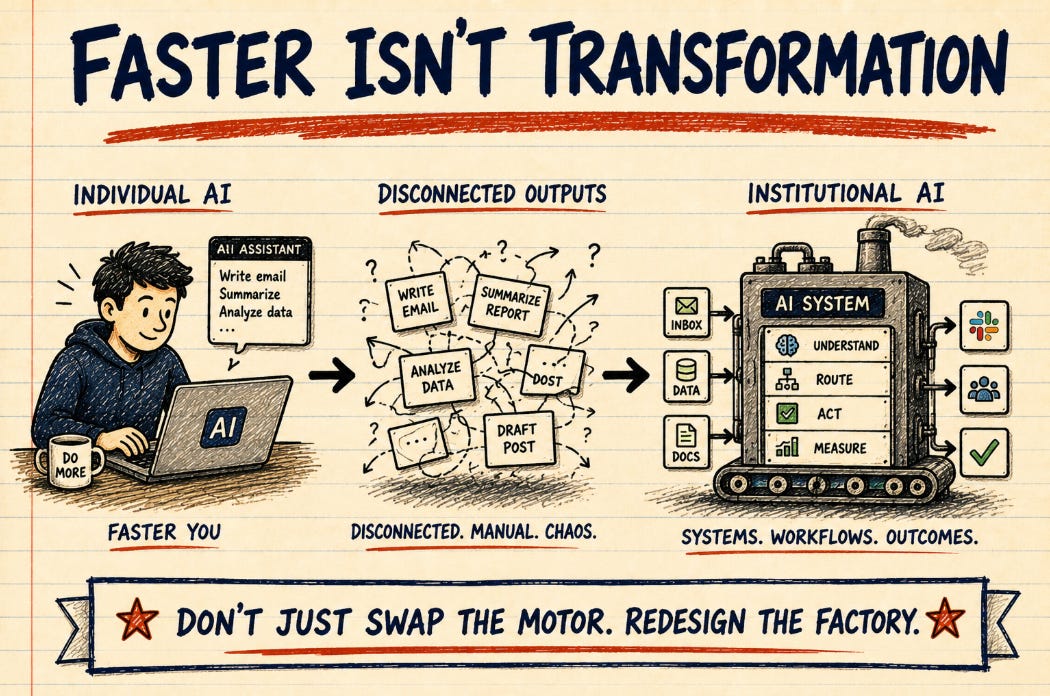
No company became 10x more valuable as a result.
So where did the productivity go?
I’ve been sitting with this question for weeks, building AI systems at a digital marketing agency - and I think I finally understand why most of what we call “AI adoption” is theater.
The electricity mistake, repeated
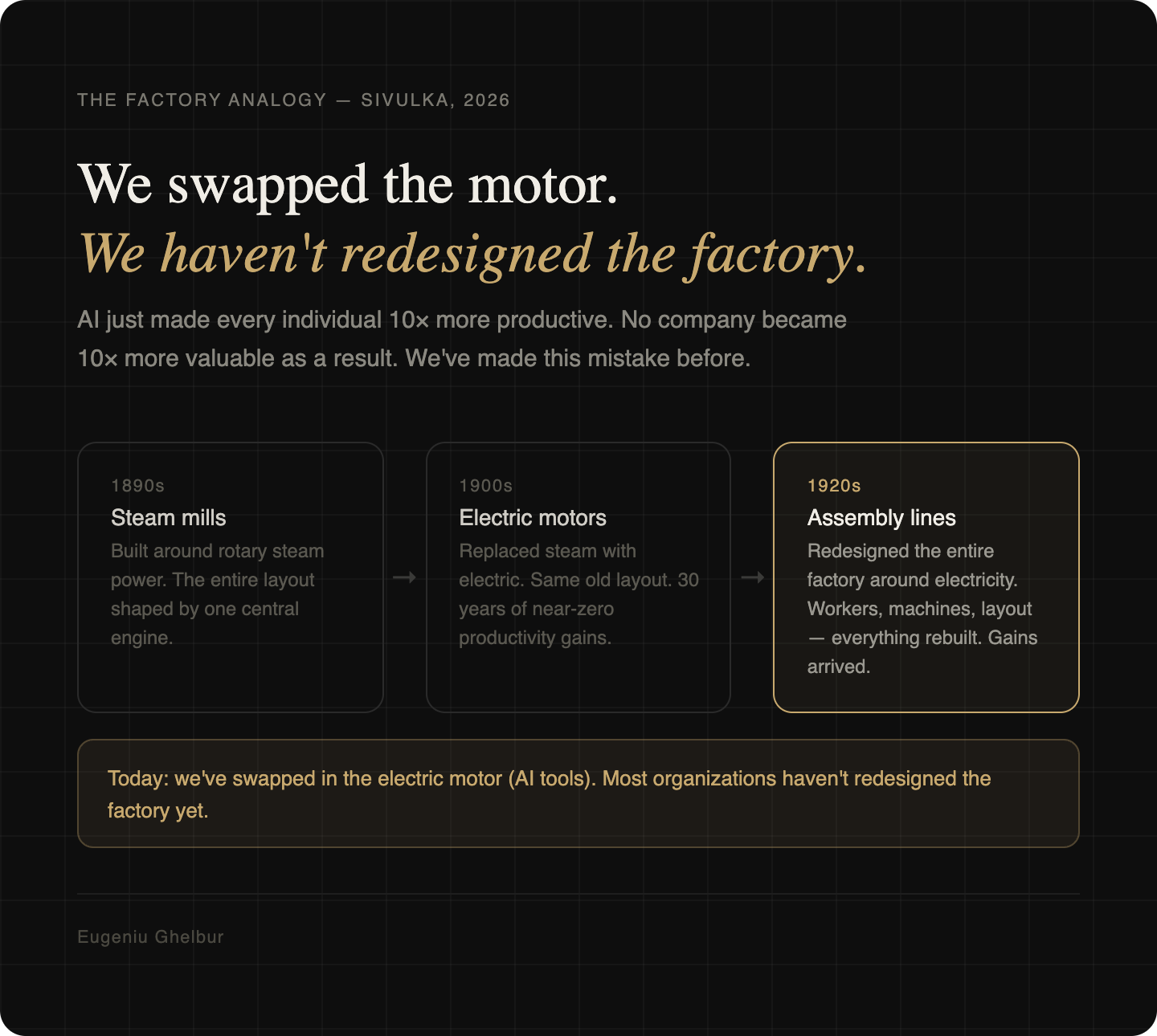
In the 1890s, New England textile mills replaced their steam engines with electric motors. Faster, cleaner, more powerful. The technology was unambiguously better.
For thirty years, productivity barely moved.
It wasn’t until the 1920s — when factories threw out the old layout entirely and rebuilt around electricity from the ground up, with assembly lines, individual motors inside every machine, and workers doing completely different jobs — that the gains arrived.
The technology was never the bottleneck. The organization was.
George Sivulka, CEO of Hebbia and a16z partner, wrote a piece this week arguing we’re making the same mistake with AI right now. We’ve swapped the motor. We have not redesigned the factory.
I think he’s right. And I think most of us can feel it, even if we haven’t named it yet.
The difference no one talks about
There are two kinds of AI being built right now.
Individual AI makes you faster. It’s the ChatGPT tab, the AI writing assistant, the personal productivity setup someone posts about on Slack to show they’re keeping up. It benefits one person. It stops when that person stops prompting.
Institutional AI makes the organization different. It runs whether anyone opens a laptop or not. It routes information to the right people. It surfaces the one real signal in a mountain of noise. It asks a human to approve something, then acts. It’s load-bearing — turning it off would actually hurt the business.
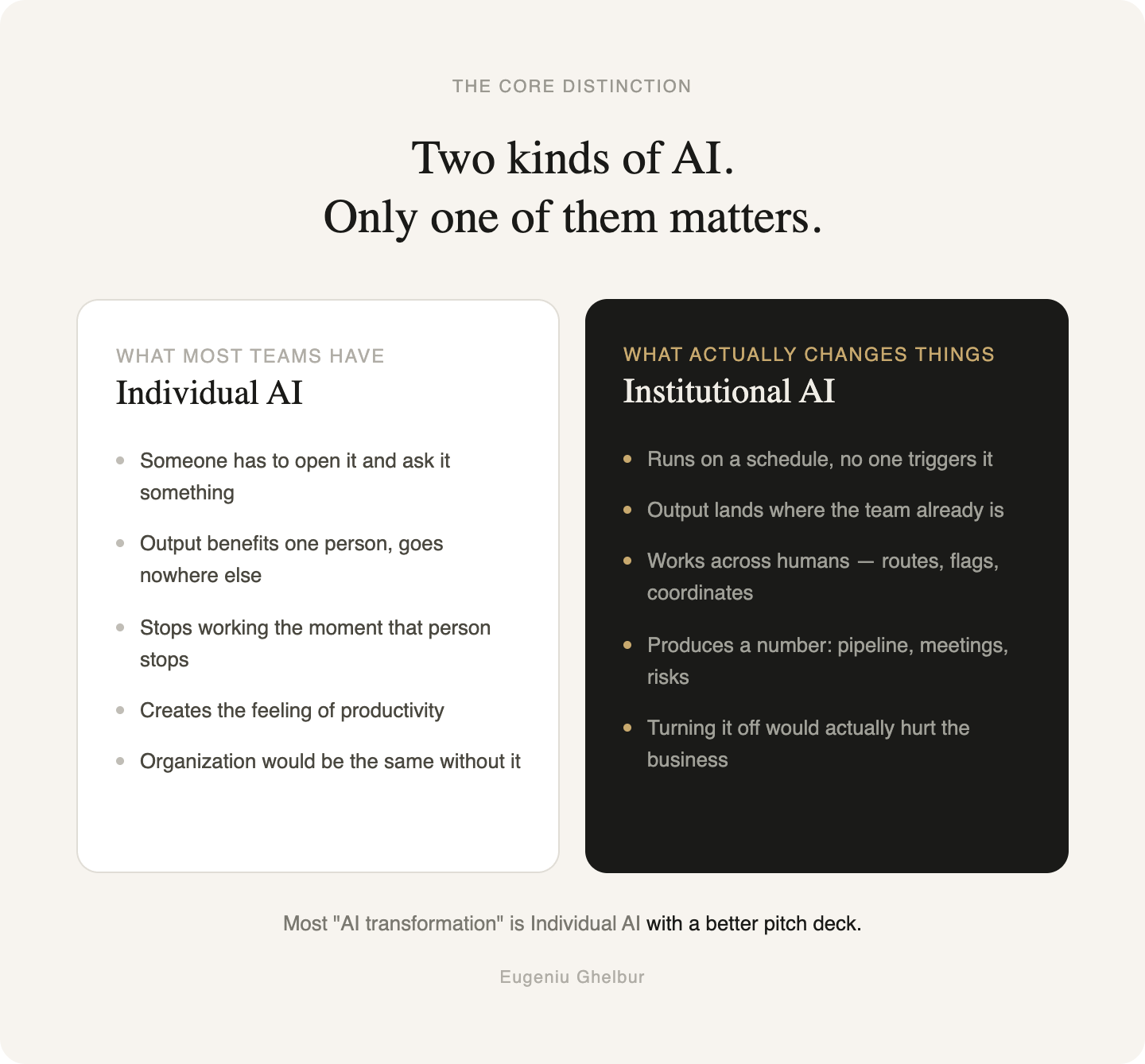
The gap between these two is enormous. And almost everything marketed as “AI transformation” is actually just Individual AI with a better pitch deck.
What this looks like in practice
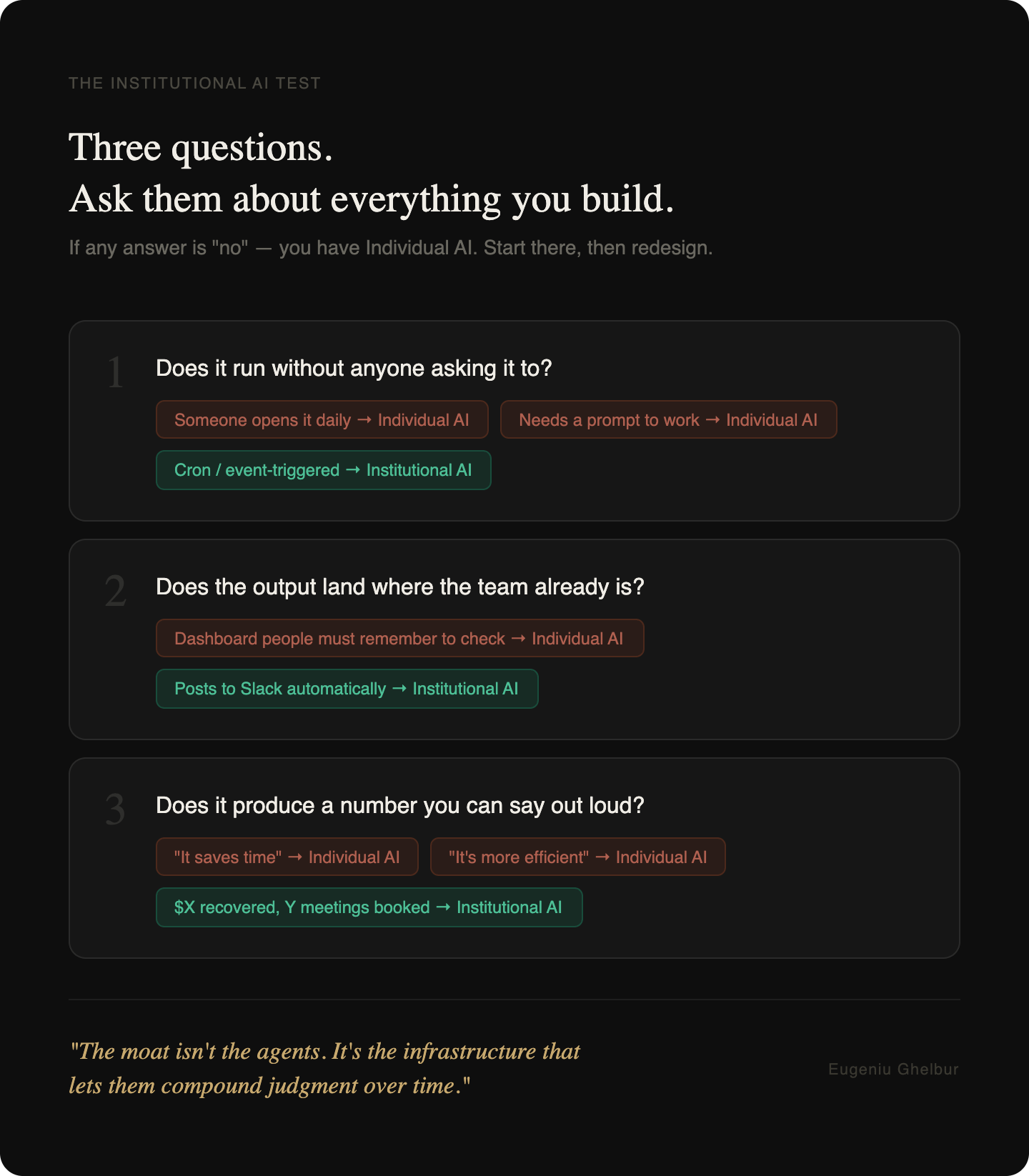
Here’s the test I use:
Does it run without anyone asking it to?
If someone has to open it, prompt it, or click generate — it’s Individual AI. Feels productive. Moves nothing.
If it wakes up at 7am, scans your pipeline, surfaces the three deals most likely to close this week, and posts them to Slack before your team’s first coffee — that’s Institutional AI. It’s a thing your organization depends on, not a tool someone chose to use today.
Does the output land where the team already is?
A dashboard requires people to remember to check it. Slack is where they already are. The difference between a dashboard and a Slack message isn’t just UX — it’s whether the insight actually reaches the person who needs to act on it.
Does it produce a number?
Not “it saves time.” Not “it’s more efficient.” A number. Pipeline recovered. Meetings booked. Churn risks flagged before they became churned clients. If you can’t say the number, the system isn’t institutional yet.
The coordination problem nobody’s solving
Sivulka’s most striking point is about coordination.
Imagine doubling your team’s headcount tomorrow with clones of your best people. Each one is individually excellent. None of them have shared context, defined responsibilities, or outputs that connect to each other.
You haven’t made your organization better. You’ve created chaos with better-dressed chaos.
This is exactly what’s happening in every company that gave everyone a ChatGPT subscription and called it an AI strategy. Everyone has their own prompts. Their own outputs. Their own version of what the AI should be doing. Nothing connects to anything else.
Institutional AI requires a coordination layer. Defined roles for each agent. Outputs that feed into other agents or into human decision-making. A shared infrastructure everyone builds on, not a hundred individual setups that happen to be in the same building.
Why this matters now
The companies building Institutional AI aren’t just more productive — they’re building something that compounds.
Every process encoded in an agent is institutional memory that survives turnover. Every workflow that runs without being triggered is leverage that doesn’t require more headcount. Every approval loop that keeps a human in the decision without slowing down the work is a way to move faster without moving recklessly.
The companies still in the Individual AI phase are getting the feeling of progress without the substance of it. Their people are faster. Their organization is the same.
We’re in the 1900s equivalent right now — we’ve plugged in the electric motors. The factories that win the next decade will be the ones that tear out the old layout and rebuild around what the technology actually enables.
The question isn’t whether your people are using AI.
It’s whether your organization is.
Excellent article and insights, it will all apply later… or in life-death-war immediately.