


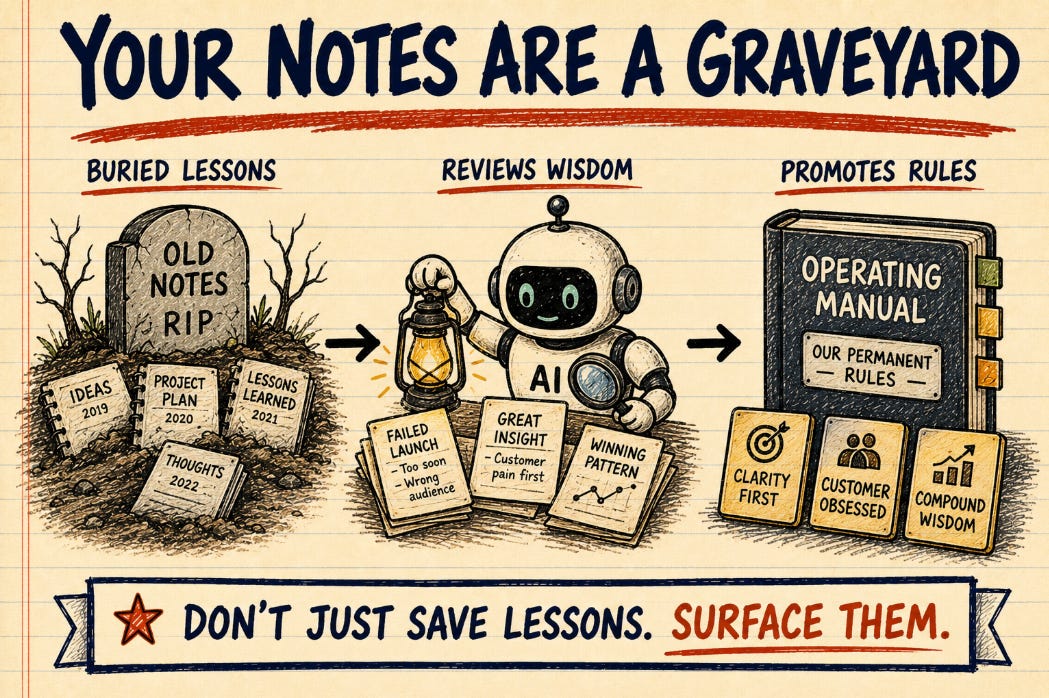
Every productive person I know writes lessons down. “Don’t sign one-year contracts without exit clauses.” “Always run migrations on a staging copy first.” “When a client goes silent for two weeks, escalate to email.”
Then they make the same mistake six months later.
The lessons aren’t lost. They’re just buried in daily notes, dev logs, and meeting recaps that nobody opens again. The wisdom rots in place.
The problem with second brains
Most note-taking advice ends at “write it down.” But writing is the easy part. The hard part is keeping the lessons alive — surfaced, reviewed, applied.
Without that step, your second brain becomes a graveyard. The more you write, the worse it gets. Important rules get drowned by daily noise. The lesson you needed yesterday was logged eight months ago, three folders deep, with no link pulling it forward.
The fix: a command that reviews your wisdom
I just shipped /obsidian-learn in my open-source Claude Code skill. It does one thing: scans your entire vault for lessons and decides which ones still matter.
Five places it looks:
“Lesson learned” sections in daily notes
Architectural Decision Records (ADRs)
Pattern reports from previous reviews
Failure-learning phrases — “next time”, “don’t do this”, “wasted time on”
Recurring success patterns — things that worked twice or more
Then it classifies each lesson:
Active — still applies, reinforced by something recent. Keep it.
Stale — six months old, no recent reinforcement. Archive or convert to history.
Superseded — explicitly replaced by a newer decision. Acknowledge the evolution.
Promotable — appeared three or more times across your vault. This is now a permanent rule. The command suggests exact wording to add to your operating manual.
What this does in practice
Run /obsidian-learn weekly. Get a report:
Top 5 Lessons of the Period
“Always verify live state before patching from memory” — 4 reinforcements. Promote to permanent rule.
“Never re-run destructive wizards” — reinforced after a recent incident.
“Talk to one named user before designing the system” — corrected twice.
“Pre-written decline scripts beat willpower” — recurring pattern across multiple weeks.
“If the side project competes with the day job for content, the side project dies” — emerged from cross-domain synthesis.
Promote the top ones into your operating manual. Now every AI session you start, on any device, opens with these rules already loaded. The wisdom you earned compounds.
Why this matters
The next decade’s competitive edge isn’t access to AI models. Everyone will have that. The edge is the corpus the model works from — your years of decisions, lessons, and patterns, organized so they actually surface when relevant.
A vault that doesn’t review itself is just a filing cabinet with extra steps. A vault that promotes its own lessons into rules becomes a personal operating system that gets sharper every quarter.
This is the latest release of obsidian-second-brain — a Claude Code skill that turns your Obsidian vault into a living knowledge base. 26 commands now. Self-rewriting ingest, thinking tools that argue with you using your own history, scheduled agents that maintain the vault while you sleep, and now a command that compounds your wisdom instead of letting it rot.
Inspired by Garry Tan’s gstack /learn pattern. Open source. MIT licensed.