


Some jobs don’t die with a bang.
They vanish slowly — until one day, you realize you're the last person still doing them.
While new careers are booming, millions of roles are quietly slipping into irrelevance.
Not because people stopped needing them — but because machines started doing them better, faster, and cheaper.
This isn’t science fiction. It’s already happening.
In Part 2 of The 2030 Work Shift, we’re pulling back the curtain on the careers fading fast — from office admin to factory floor. If you’re in one of these roles, this isn’t a panic button... it’s a flashlight.
Let’s talk about what’s falling behind — and what you can do before it’s too late.
💀 Why Jobs Are Disappearing
Spoiler: It’s not because people got lazy.
The death of a job rarely comes overnight. It comes from a thousand cuts — automation, outsourcing, new tech, shifting consumer habits, and straight-up irrelevance. Here are the big forces quietly phasing out millions of roles:
⚙️ 1. Automation is eating the routine.
If your job is predictable, repeatable, or rule-based… a robot wants it.
From cashiers to bookkeepers, anything that can be mapped in steps is being mapped out.
“For more about how automation is impacting jobs, see the Bureau of Labor Statistics for projections.”
🌐 2. Software is replacing middlemen.
Want to book a flight? You don’t call a travel agent.
Need accounting help? There’s an app for that.
The internet turned entire careers into features.
💸 3. Businesses are chasing efficiency.
It’s not personal — it’s math. If a machine or an offshore team can do the same job cheaper, the job vanishes. Entire departments are now “automated workflows.”
👶👴 4. Demographics are shifting demand.
As populations age, demand for education, retail, and manual clerical work shifts. Some jobs fade just because younger generations don’t want — or need — them anymore.
🤖 5. AI is coming for the “safe” jobs too.
It’s not just truck drivers or factory workers. AI is writing content, drafting contracts, designing websites, and even coding.
The threat isn’t blue- or white-collar. It’s routine-collar.
🔵 Worst White-Collar Jobs for 2030
They used to be safe. Now, they’re circling the drain.
These roles aren’t disappearing because they’re unimportant — they’re disappearing because software does them faster, cheaper, and without sick days.
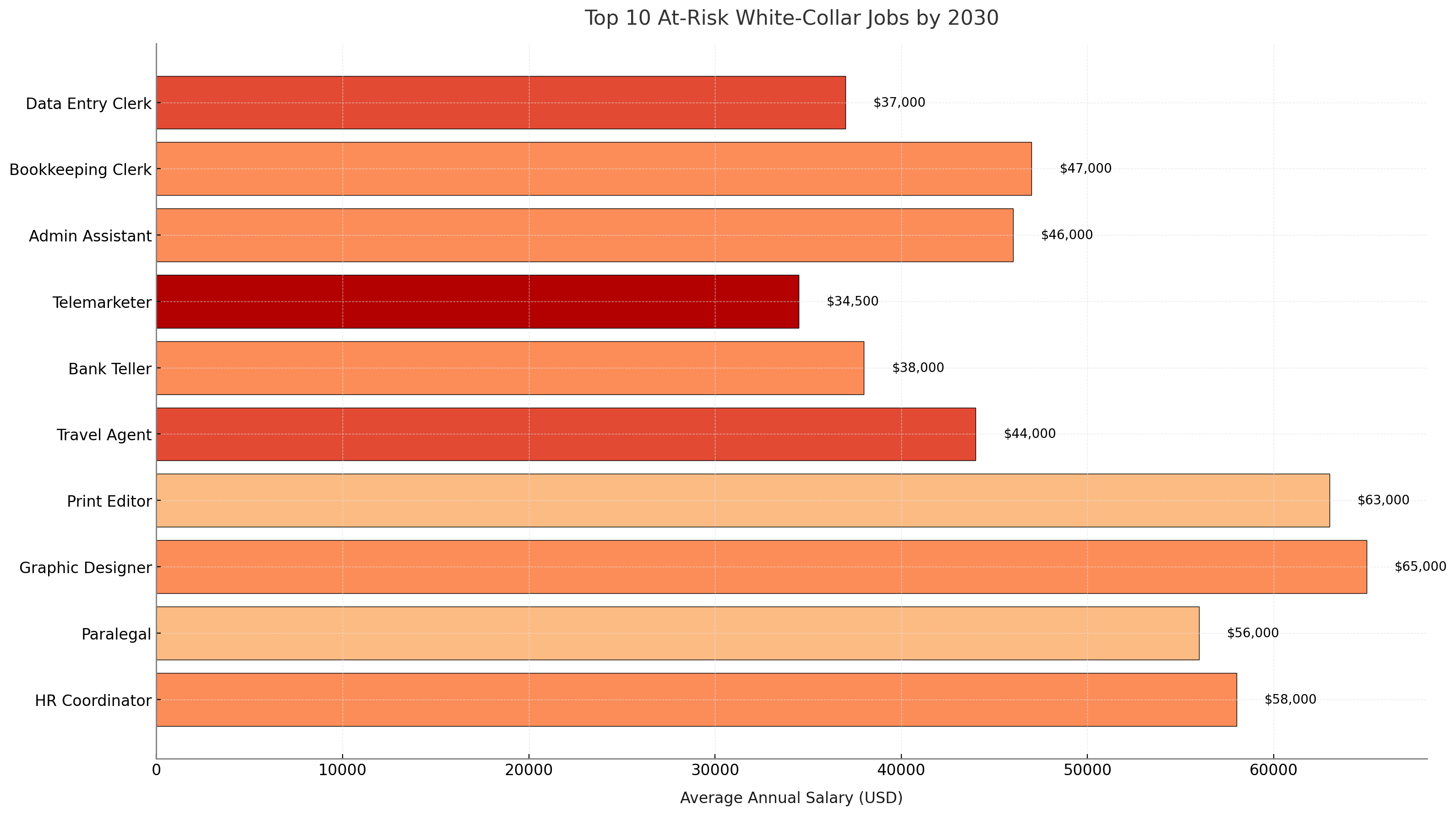
Let’s break them down:
1. Data Entry Clerk
Once essential. Now basically a Ctrl+C, Ctrl+Z function.
Why it’s dying: OCR, RPA, AI — all doing it better
Median salary: ~$37,000/year
Automation risk: Very High
2. Bookkeeping / Accounting Clerk
Small biz software like QuickBooks, Xero, and AI bookkeeping tools are replacing entire teams.
Why it’s dying: Automated financial tracking is the norm
Median salary: ~$47,000/year
Automation risk: High
3. Administrative Assistant / Secretary
Calendar? Automated. Notes? Transcribed. Scheduling? AI can handle it — badly, but getting better.
Why it’s dying: Executive software + remote work = less need
Median salary: ~$46,000/year
Automation risk: High
4. Telemarketer / Call Center Agent
When was the last time you said “Sure, tell me more!” to a cold call?
Why it’s dying: Robocalls, chatbots, voice AI
Median salary: ~$34,500/year
Automation risk: Extremely High
5. Bank Teller
ATM + mobile app = “Why go to a branch?”
Why it’s dying: Digital banking = fewer humans behind the counter
Median salary: ~$38,000/year
Automation risk: High
6. Travel Agent (non-specialized)
If your job can be replaced by Google Flights, it will be.
Why it’s dying: DIY travel tools, instant booking platforms
Median salary: ~$44,000/year
Automation risk: Very High
7. Publishing Editor (Print)
Print is not dead. It’s just… sleeping. And digital took its job.
Why it’s dying: Decline in traditional publishing, rise of self-pub & AI editing
Median salary: ~$63,000/year
Automation risk: Medium-High
8. Graphic Designer (Basic Work)
If your design style screams “2012 Canva template,” you’re already out.
Why it’s dying: Generative AI (like Midjourney, DALL·E) replacing static design
Median salary: ~$65,000/year
Automation risk: High (for low-complexity work)
9. Paralegal (Document-Heavy)
AI now drafts contracts faster than interns — and without lunch breaks.
Why it’s dying: Legal tech platforms, contract AI, NLP tools
Median salary: ~$56,000/year
Automation risk: Medium-High
10. HR Coordinator (Admin-Level)
Hiring platforms and AI screeners are automating the most tedious HR tasks.
Why it’s dying: Applicant tracking, workflow tools, auto-screening
Median salary: ~$58,000/year
Automation risk: High (for non-strategic roles)
🔴 Worst Blue-Collar Jobs for 2030
Repetitive. Predictable. Easy to replace. That’s the red flag combo.
These roles are being eaten alive by robots, kiosks, and algorithms. In some places, they’re already gone. The danger here? Many of them still feel stable — until they vanish.
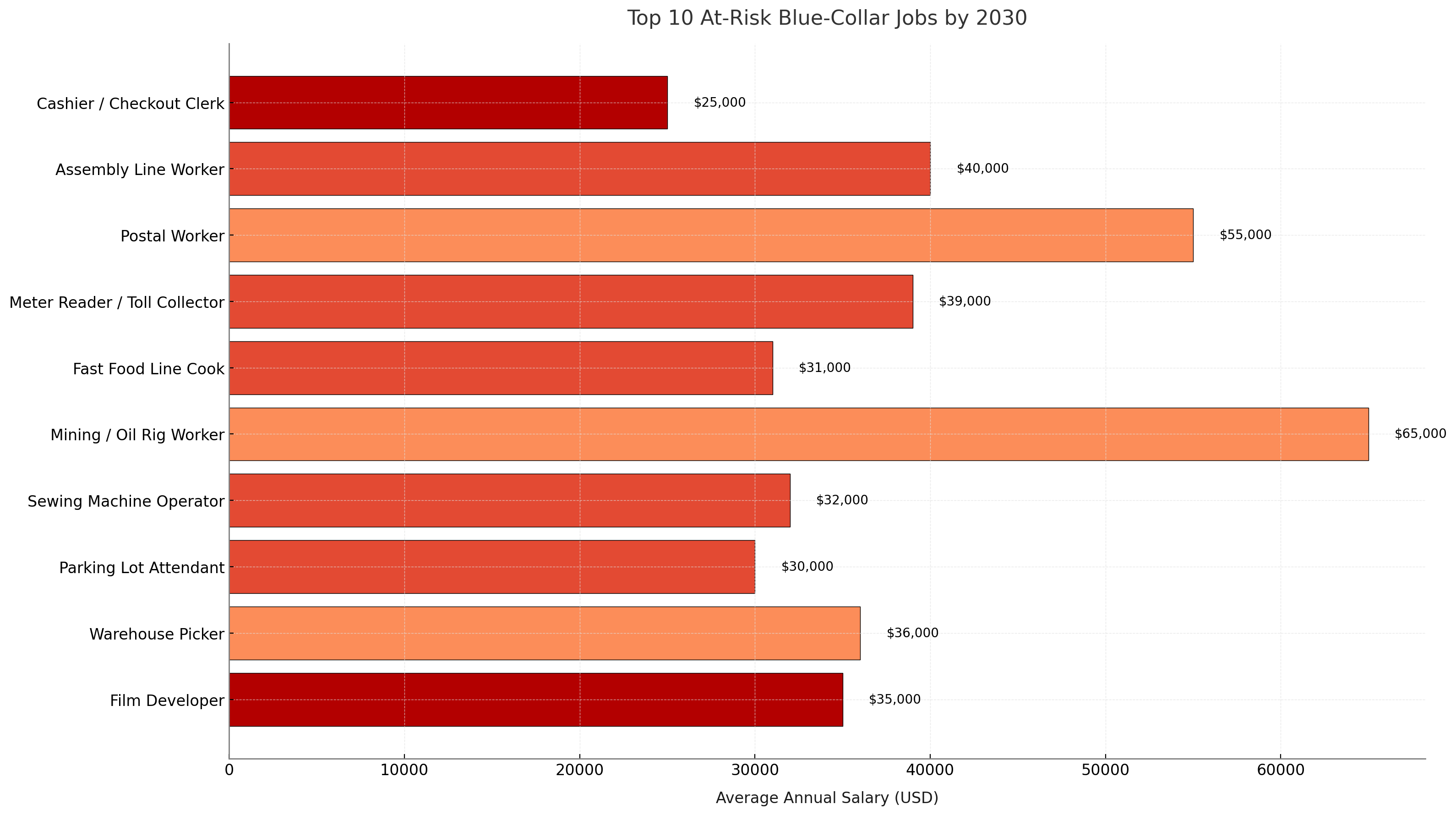
1. Cashier / Checkout Clerk
Self-checkout is now standard. And no, the machines don’t care how your day is going.
Why it’s dying: Kiosks, apps, and online retail
Median salary: ~$25,000/year
Automation risk: Extremely High
2. Assembly Line Worker / Factory Operator
Industrial robots don’t take lunch breaks. They just take jobs.
Why it’s dying: Full automation in predictable environments
Median salary: ~$40,000/year
Automation risk: Very High
3. Postal Worker / Mail Sorter
When was the last time you sent a letter that wasn’t a wedding invite?
Why it’s dying: Email, digital billing, automated sorting
Median salary: ~$55,000/year
Automation risk: High
4. Meter Reader / Toll Collector
Sensors and smart infrastructure make this role obsolete — literally.
Why it’s dying: Automated utility tracking & digital toll systems
Median salary: ~$39,000/year
Automation risk: Very High
5. Fast Food Line Cook (Chains)
Robotic burger flippers. Touchscreen orders. Fewer humans, more efficiency.
Why it’s dying: Automated kitchens & AI-driven prep lines
Median salary: ~$31,000/year
Automation risk: Very High
6. Mining / Oil Rig Worker
High-risk, high-cost, and high on the automation hit list. Add climate policy, and it’s a perfect storm.
Why it’s dying: Mechanization + energy transition
Median salary: ~$65,000/year
Automation risk: High
7. Sewing Machine Operator (Textiles)
In developed countries, it’s mostly gone. In developing ones, it’s going.
Why it’s dying: Automated garment manufacturing
Median salary: ~$32,000/year
Automation risk: Very High
8. Parking Lot Attendant
Kiosks, apps, and ANPR cameras are eliminating this role almost everywhere.
Why it’s dying: Digital payments, license plate scanning
Median salary: ~$30,000/year
Automation risk: Very High
9. Warehouse Picker / Sorter (Non-Robotized)
Amazon already has bots that sprint. Humans don’t stand a chance.
Why it’s dying: Robotic sorters, smart warehouses
Median salary: ~$36,000/year
Automation risk: High
10. Photographic Processor / Film Developer
Kodak called. It’s over.
Why it’s dying: Smartphones + digital imaging
Median salary: ~$35,000/year
Automation risk: Maxed Out
🧨 What These Jobs Have in Common
They’re not all the same industry, but they’re all on the same sinking ship.
When you zoom out, the dying jobs of the 2030s all share the same fatal flaws. Here’s what ties them together:
🔁 1. They’re repetitive.
If your work is the same hour after hour, day after day — it’s ripe for automation.
Machines love routine. Employers love cutting costs. You do the math.
🧠 2. They don’t require high-level thinking.
No judgment, no problem-solving, no context? That’s exactly what AI excels at replacing.
If your job feels “plug-and-play,” it might soon be plug-and-replace.
💡 3. They offer little human creativity or empathy.
If no part of your job depends on emotional intelligence, original ideas, or human presence — it’s vulnerable.
Even customer service is being AI’d into oblivion.
🧰 4. They haven’t changed in years.
Stagnant roles don’t survive in dynamic economies.
If the job looks exactly like it did in 2005, odds are it won’t exist in 2030.
🚫 5. They’re getting absorbed by tech or skipped altogether.
Some roles aren’t being “replaced” — they’re just being bypassed.
Why hire a human to run a toll booth when your license plate can do it automatically?
The takeaway? These jobs are fading not because they’re unworthy — but because technology doesn’t need them anymore.
Next up: the consequences of holding on too long.
⚠️ Why Clinging to These Jobs Is Risky
Sometimes loyalty to the wrong role can wreck your future.
People don’t stay in dying careers because they’re lazy.
They stay because it’s familiar. Comfortable. "Safe."
Until it’s not.
Here’s why staying too long in the wrong job can cost more than your salary:
🧱 1. You miss the momentum shift.
While the world is upskilling, pivoting, and learning new tools… you're stuck.
The longer you wait, the steeper the hill gets. And eventually, the skills gap swallows you.
⏳ 2. You invest in a dead end.
More time = more sunk cost = more fear of leaving.
But jobs don’t reward emotional attachment — they reward adaptability.
🧩 3. You lose visibility.
Dying roles get fewer promotions, less leadership attention, and lower budgets.
It’s not a fast fall — it’s a quiet fade into irrelevance.
📉 4. Your skills depreciate.
The market doesn’t care what you did in 2016.
If your skillset isn’t evolving, your market value is silently dropping every year.
🛑 5. You miss the window to pivot.
There’s a sweet spot where you still have time to reskill before you need to.
Once the layoffs start, that window’s gone — and you’re learning under pressure.
Bottom line:
The cost of staying still is rising.
The safest move isn’t staying where you are — it’s preparing for where you need to go.
Next up: the series teaser for Part 3 — The Shift. Want to roll into it?
Let’s talk about the now, and the future. We have labor shortages of hands on.
Here’s a org that has been on reshoring for over a decade, and yes manufacturing.
https://reshorenow.org/
Assembly mag - see additive manufacturing aka 3d printing
https://www.assemblymag.com/
a16z.com Andreessen Horowitz especially on AI - and Defense and space.
https://a16z.com/american-dynamism-50-2025/
Finally let’s talk about Infrastructure. The real infrastructure is going to remain hands on. So electricians, HVAC, Fiber Splicers (that is extremely delicate work splicing glass fibers) and anyone who has SKILLED hands on and is a reliable and trainable employee has a future. As for AI its chief gain is machine learning machines (additive manufacturing with AI can instantly get feedback and self correct as prototype as it “prints” for example). Rednecks are all over 3D printing (admittedly often to make Cannibis paraphernalia or guns , but The Wright Brothers were smart rednecks you know) and rednexx will learn AI as tool.
Follow that assembly mag, that’s now and next…
Profound on Routine Collar.
On all - Human beings, lawyers, HR all very stubborn and persistent, we’ll see. They are good at rigging the system.
Blue …
On oil rig worker and assembly line worker - or rather hands on for both and manufacturing in particular I am really going to need to see these plants and rigs operational now and profitable 3 years to believe. Musk looked at automation for factories and stepped back, as the Germans for example had results indicating that overall automation didn’t reduce headcount, as other hands were needed to finish or fix behind the robots.
I’m not an oil rig worker, but I again need to see these automated oil rigs that self assemble and build <